Wide-Set Eyes · Natural · Volume
The natural lash map for wide-set eyes, built in Volume — zone order, where the length peaks, and the point this one usually goes wrong.
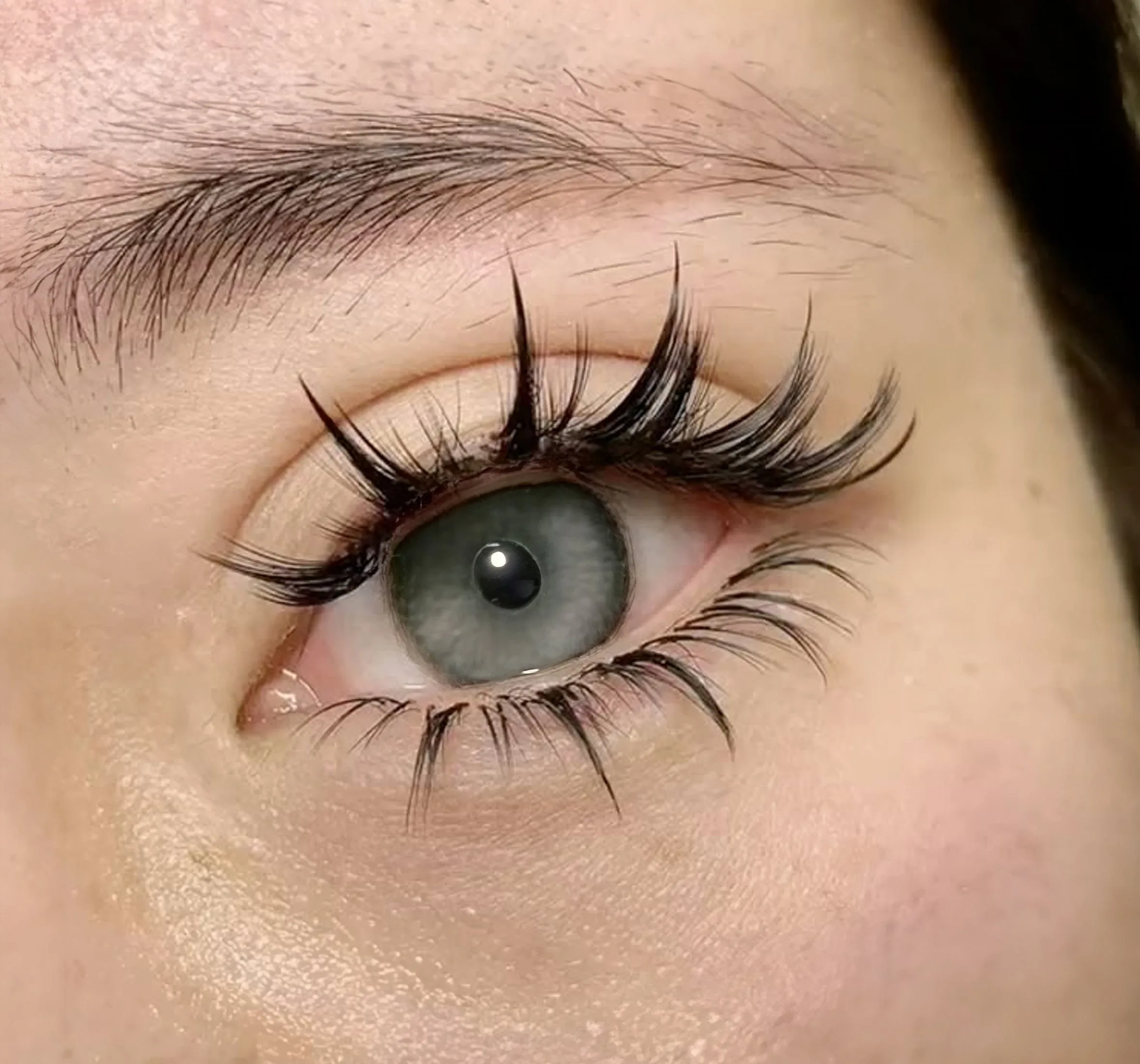
- ShapeWide-set — distance between the eyes, not the eye shape itself.
- EffectNatural in volume: soft density gathered toward the middle.
- Where everyone strugglesFullness follows the length curve. Even density kills it.
Why Why it is laid out this way
Volume on a natural map is a balancing act at the best of times, and this one adds a spacing correction underneath. The gain is real — fine fans let the inner corner sit full without asking those lashes to grow longer. The risk is that density flattens the gradient the correction depends on.
The order the zones go on, fan by fan
- Map in light fansRun a full base of narrow fans along the whole curve before building anything up. The shape has to exist in the base.
- Weight the inner halfBuild fullness from the inner corner to the peak pair so the darkest part of the line sits inboard.
- Keep the peak levelThe two peak zones share the same length and the same fullness. A level top reads natural; a single high point reads styled.
- Fade toward the cornerFullness and length drop together across the outer third. Finish thin and short.
- Watch the inner weightNarrow fans at the very inner corner. Full ones there look right on day one and sit low by the second week.
The length curve on wide-set eyes
The curve rises early, holds level across two zones and then falls to its shortest point at the outer corner. In volume the darkness has to trace the same line, because the eye judges size by darkness at least as much as by length — an evenly dense set erases the gradient and hands back the correction, however carefully the lengths were mapped. Read the diagram as a density chart too.
Where does a natural map go wrong on wide-set eyes?
Deep The physics underneath
Volume's discount is coverage for less mass. On this map the discount is spent almost entirely in one place, and it is worth knowing why.
The same map, built four ways
- Classic 1:1
- Singles would force the inner fullness to come from length, on the least capable lashes on the eye. Keeping a few singles in the outer third is still worth doing — they keep the fade honest where fans would look abrupt.
- Handmade volume
- The point of this cell. Several fine strands read as fullness at the inner corner for a fraction of the mass a longer single would need, which is the only affordable way to close the gap beside the nose.
- Promade / pre-made fans
- Consistency across a soft base, with a small node of mass at the root where the lever is shortest. The fixed spread is a poor fit inboard, where this map wants narrow fans on fine lashes.
- Woven / clover
- Excellent coverage per bond and a shape that repeats identically. A natural set cannot show a repeat, and this one especially cannot show one running out toward the corner.
Spread angle versus weight
The peak pair holds the longest strands, but the spread decision that matters is at the inner corner. Wide fans there put mass off the axis of lashes with the least stiffness to resist a twist, and twisted inner fans look scruffy long before they look sparse. Narrow inside, moderate at the peak, narrow again as you fade out.
What a wide-set lash line can carry
- Fanning changes what a given darkness costs, not what the lash will hold. The inner corner is asked for the most darkness relative to what it can carry, so it is the zone that sets this map's limit.
- Deflection arrives before shedding. On this set the first sign is the level top of the peak pair developing a tilt, not lashes turning up on the tape.
- The finest strands in a zone decide when it fails, and the inner corner has the widest spread between finest and average. That is why the same fullness holds beautifully on one client and sits low on the next.
Where this map fails first
The inner corner, first and most visibly. It carries the fullest fans relative to what its lashes can hold, because the map leans on it to close the gap beside the nose. Failure there shows as fans dropping and turning rather than disappearing, and once they sit low the correction is gone even though the set still looks dense. Everything else on this map ages slowly by comparison.
FAQ Common questions
Can a volume set really look natural on wide-set eyes?
Yes, if the density follows the length curve instead of running flat. Fine fans, level peak, thin fade to a short tail — the fullness reads as her own lashes on a good day.
Where is the fullest part of the set?
The inner half, from the corner through the peak pair. That is the opposite of most volume sets and it is the entire correction.
Why do the inner fans have to be narrow?
Because the lashes there are the finest on the eye and a wide fan twists them. A narrow fan gives you the darkness without the rotation.
How short should the outer corner finish?
Shortest and thinnest on the map. Length and density both taper out there, because either one on its own is enough to make the eyes read further apart.
Print this page or save it as PDF — the diagrams are drawn to stay readable in black and white on plain paper. Or download the diagrams below as SVG. No account, no fee, nothing to sign. Every file carries this page’s address, so wherever it ends up it can be traced back here.
Teaching from these? The offer, and how to credit it.
Also in: Wide-Set eyes · Natural · Volume
Read next: questions clients ask about lash extensions