Wide-Set Eyes · Squirrel / Fox · Classic 1:1
The squirrel lash map for wide-set eyes, built in Classic 1:1 — zone order, where the length peaks, and the point this one usually goes wrong.
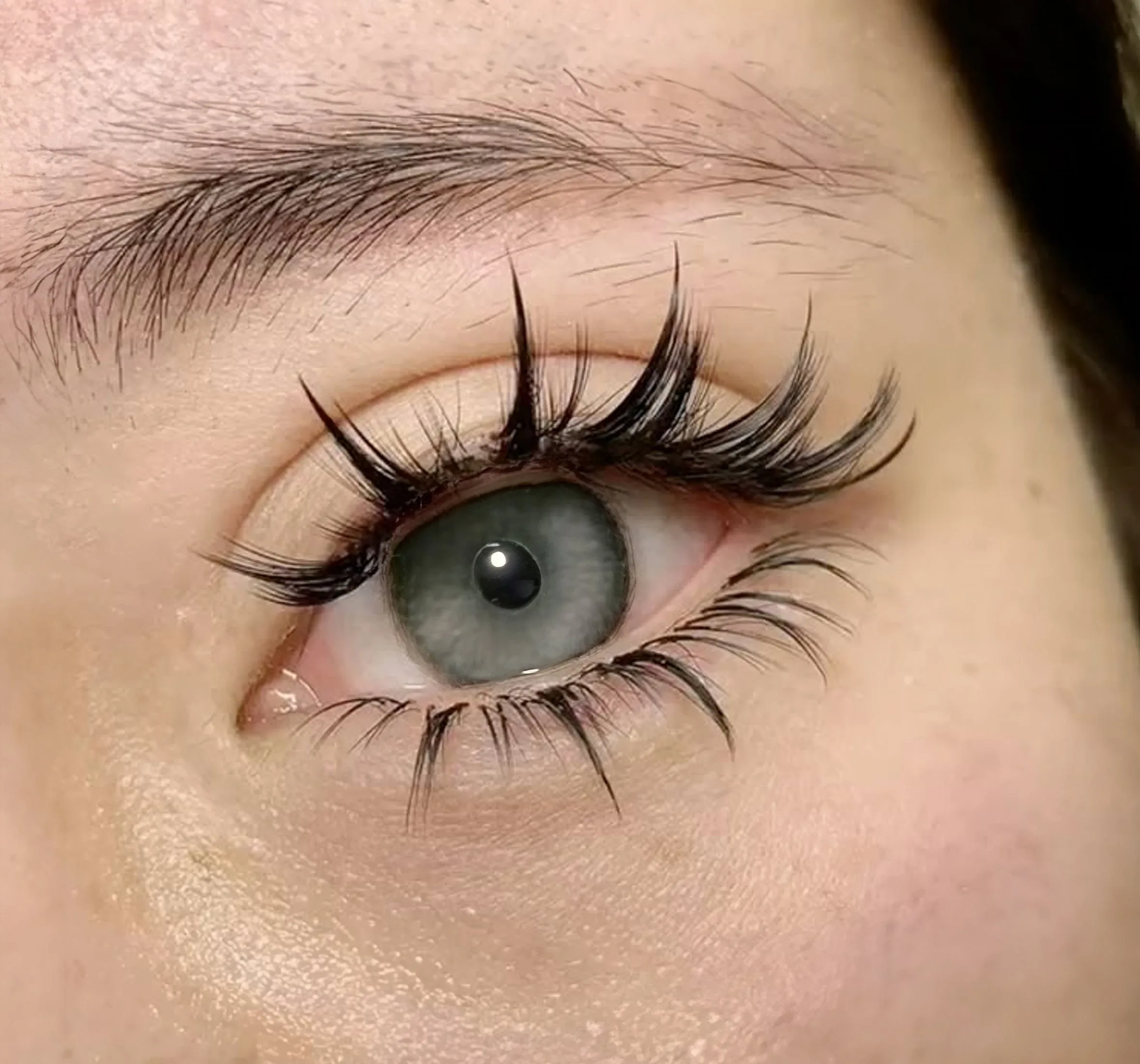
- ShapeWide-set — the inner corners sit far from each other.
- EffectSquirrel with the arch moved one zone in: lift, no outward reach.
- Where everyone strugglesThe drop after the peak is the correction. Do not soften it.
Why Why it is laid out this way
A squirrel map lifts under the arch and then falls to the corner, which already suits eyes that must not carry weight outward. Moved one zone further in, it suits them better still — the lift lands over the pupil-to-iris band and the fall starts earlier. In classic 1:1 that drop is drawn purely in length, so it has to be steep to be seen.
The order the zones go in
- Accept a short startNothing on this map is shorter than the zone nearest the nose. A squirrel needs a low start and this version accepts it rather than faking a fuller corner.
- Climb to the archThree quick steps up. The rise is what the eye reads as lift.
- Peak one zone inwardHold the two longest zones over the pupil-to-iris band, not out at the outer iris. That single shift is the wide-set adjustment.
- Drop after the peakFall by nearly half in one step, then again to the corner. A gentle fall turns this map into a cat.
- Hold a single curlOne curl family throughout. A stronger curl at the tail is how outward pull usually sneaks back in.
The length curve on wide-set eyes
The line climbs, holds two zones and then falls in two large steps to the shortest length at the corner. That fall is where the correction lives: on wide spacing the eye measures distance by where the lash line stops being interesting, and this map makes it stop early. The lift is why the client asked; the drop is why it works on her.
Where does a squirrel map go wrong on wide-set eyes?
Deep The physics underneath
The peak pair sits one zone inboard of where a squirrel normally lands, which changes which lashes are carrying the set.
The same map, built four ways
- Classic 1:1
- With singles the lift is entirely a length story, so the steps have to be big enough to see and small enough not to show as jumps. The shifted arch helps, because it puts the longest strands on stronger lashes than the usual placement does.
- Handmade volume
- Fans would let the arch read taller through darkness rather than length. Not this cell's job, but it is the answer when her mid-lid lashes cannot hold the peak pair in singles.
- Promade / pre-made fans
- Quick and consistent, and consistency is not what a two-step fall needs — the drop after the peak is meant to be abrupt and pre-set bases encourage evenness. Keep them to the climb if used at all.
- Woven / clover
- Good coverage per bond, repeating shape. On a map defined by a sharp change of direction, a repeat blurs the exact point the whole design turns on.
Spread angle versus weight
There is no fan spread in a 1:1 set, but the placement angle at the peak pair does the same work. Those two zones hold the longest strands on the map, and any bond set off the lash's own line becomes a twist that shows as the arch leaning outward — the direction this map exists to avoid. Set both peak zones square before drawing the fall.
What a wide-set lash line can carry
- Moving the arch inward puts the longest strands on stronger lashes, so this version has more headroom than a standard squirrel. That is a genuine mechanical benefit, not only a visual one.
- Length still costs mass and lever together, which is why the fall is easy to hold — the zones past the arch are being asked for very little.
- A zone fails at its finest strands. Here the finest strands are also the least loaded ones, at both ends of the map, which is why this shape ages more gracefully than most on this spacing.
Where this map fails first
Outer of the two peak zones. It carries the same length as its neighbour on slightly finer lashes, so it deflects first, and when it does the flat top of the arch tilts toward the temple. The set does not look sparse at that point — it looks like a cat-eye, which on this spacing is worse than looking thin. Judge the fill date by whether the arch is still level, not by how full the line is.
FAQ Common questions
Why move the arch inward on wide-set eyes?
Because the standard squirrel arch sits out near the outer iris, and length that far out reads as distance between the eyes. One zone in keeps the lift and drops the widening.
Isn't squirrel already a safe map for wide-set eyes?
Safer than cat, because of the fall after the peak. Shifting the arch inward is what turns safe into corrective.
How steep should the fall be?
Steep. Roughly half the peak length in the next zone and shorter still at the corner — a gentle fall reads as a cat-eye rather than a squirrel.
Does this map fix the gap beside the nose?
No, and that is its honest limitation. The inner corner stays short here, so if the gap is her main concern, map her doll instead.
Print this page or save it as PDF — the diagrams are drawn to stay readable in black and white on plain paper. Or download the diagrams below as SVG. No account, no fee, nothing to sign. Every file carries this page’s address, so wherever it ends up it can be traced back here.
Teaching from these? The offer, and how to credit it.
Also in: Wide-Set eyes · Squirrel / Fox · Classic 1:1
Read next: fox eye and squirrel lash mapping, and how they differ · questions clients ask about lash extensions