Wide-Set Eyes · Squirrel / Fox · Hybrid
The squirrel lash map for wide-set eyes, built in Hybrid — zone order, where the length peaks, and the point this one usually goes wrong.
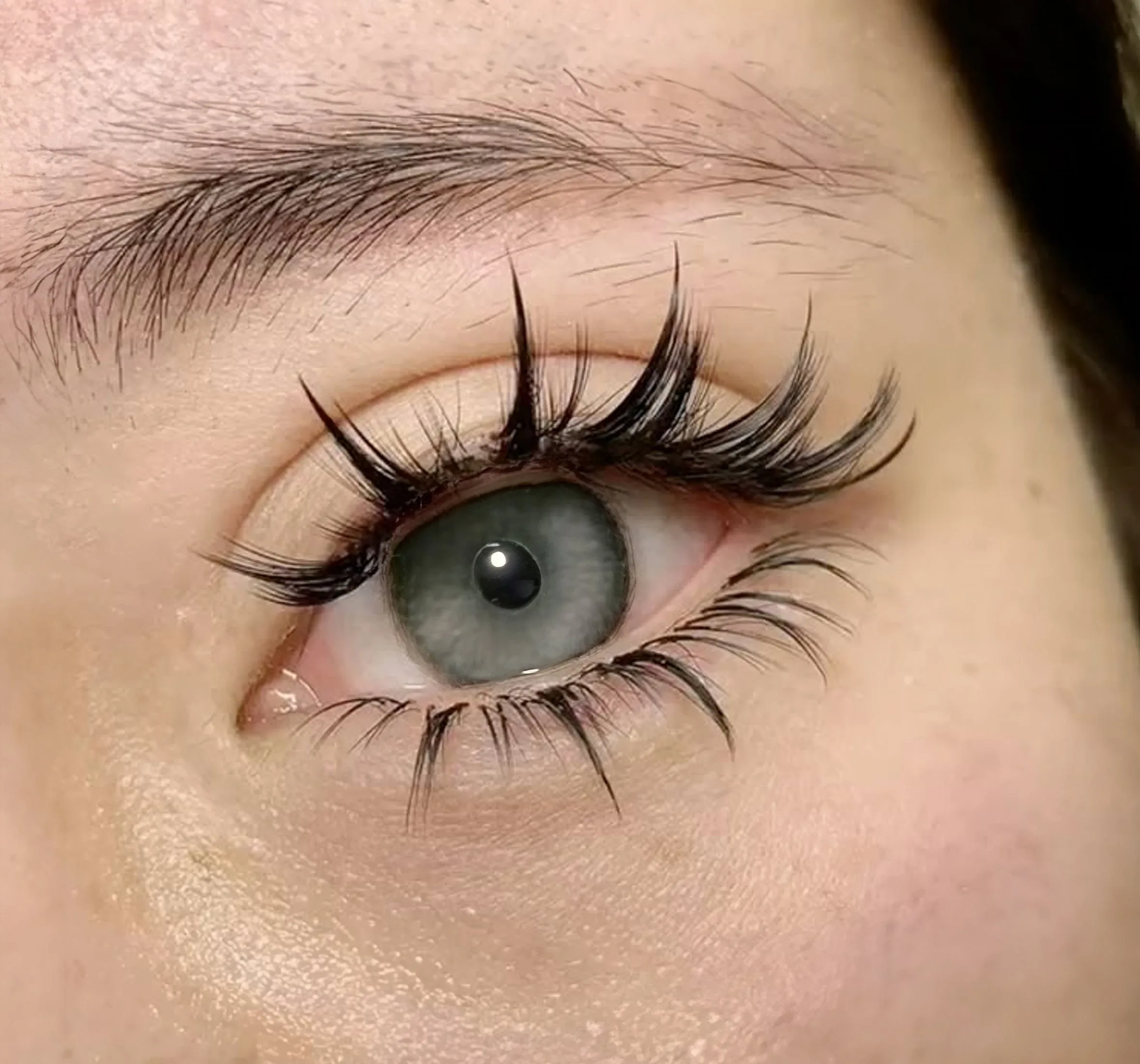
- ShapeWide-set — extra space across the nose, so nothing goes outward.
- EffectSquirrel in hybrid: lift under an inward arch, textured climb.
- Where everyone strugglesNo texture after the peak. The fall must stay plain and fast.
Why Why it is laid out this way
Texture is the reason to run this map in hybrid, and the arch position is the reason it works on this spacing. Mixed singles and fans build the climb, the two peak zones sit one step in from where a squirrel usually arches, and past them the line goes plain and drops fast. Every decision after the peak is about getting the eye to stop.
The order the zones go on, and where the fans land
- Draw the climb firstSet the length steps in singles, from the short inner start up to the peak pair, before adding fans.
- Fan the rising zonesSoft fans between the singles across the climb. Density rising with length is what makes the arch look tall.
- Level the peak pairTwo zones at full length, level, sitting one step inboard of the usual squirrel arch.
- Go plain past peakSingles only after the arch, dropping hard. The fall is the correction and texture blurs it.
- Spike the climb onlyA scatter of closed fans, all of them before the peak. Past it they act as arrows pointing at the temple.
The length curve on wide-set eyes
The shape is a fast climb, a level pair and a two-step fall to the shortest zone at the corner. In hybrid you draw that twice — once in length, once in texture — and the two drawings have to agree. Busy on the way up, plain on the way down, and the eye ends where the map wants it.
Where does a squirrel map go wrong on wide-set eyes?
Deep The physics underneath
Mixed loads on a map with a deliberate cliff in the middle of it. Which side of the cliff a load sits on changes what it costs.
The same map, built four ways
- Classic 1:1
- The singles hold the shape, and they are the only thing past the arch. Their discipline out there is the correction — a fan or a long single in the falling zones undoes everything the climb built.
- Handmade volume
- Fans give the climb its darkness for far less mass than lengthening would, which lets the arch look taller without loading the peak lashes further. Widen through the rise, narrow at the peak pair.
- Promade / pre-made fans
- Even, quick, and slightly against this map's grain, because a squirrel arch wants a rising gradient rather than a constant one. Fine through the middle of the climb, wrong at the peak where the spread should be tightening.
- Woven / clover
- High coverage per bond, and a repeat the eye tracks along the line. Tracking up toward the arch is useful; tracking past it is the failure this shape exists to prevent.
Spread angle versus weight
Spread relocates mass rather than reducing it, and the relocation matters most at the peak pair. Those two zones already carry the longest strands, so a wide fan there twists and the level top of the arch begins to lean toward the temple. Widest through the rise, tightest at the arch, nothing at all past it.
What a wide-set lash line can carry
- Because the arch sits one zone inboard, the heaviest load lands on stronger lashes than a standard squirrel uses. Hybrid spends that headroom on fans in the climb rather than on more length at the top.
- A fan and a single of equal length are not equal loads — the fan is lighter but sits off-axis, and off-axis loads rotate instead of drooping. On the climb rotation is invisible; at the arch it is the whole shape.
- Zones fail at their weakest strands and a mixed line hides which those are. On the peak pair, check lash by lash before deciding it can take another fan.
Where this map fails first
The arch first. Its outer zone sits on finer lashes than its neighbour while carrying the same length and often the same fan, so it deflects and the level top tips outward — at which point a squirrel that was correcting becomes a cat that is not. The corner is the second and gentler failure: it holds almost nothing, so when it empties the line simply ends a little early. Only the first one costs you the correction.
FAQ Common questions
Why is squirrel a natural fit for wide-set eyes?
Because it drops after its peak instead of running long to the corner. Shifting the arch one zone inward makes it corrective rather than merely harmless.
Where do the spikes go?
On the climb, before the arch, never after it. Spikes are the brightest points on a hybrid set and this spacing cannot afford bright points at the far edge.
Should the fans get fuller toward the arch?
Fuller through the climb, then narrower right at the peak pair. Rising density reads as lift, but a wide fan on the longest strands rotates.
What does this map not fix?
The gap beside the nose. The inner corner stays short here, so a client mostly bothered by that empty look wants a doll map instead.
Print this page or save it as PDF — the diagrams are drawn to stay readable in black and white on plain paper. Or download the diagrams below as SVG. No account, no fee, nothing to sign. Every file carries this page’s address, so wherever it ends up it can be traced back here.
Teaching from these? The offer, and how to credit it.
Also in: Wide-Set eyes · Squirrel / Fox · Hybrid
Read next: fox eye and squirrel lash mapping, and how they differ · questions clients ask about lash extensions