Wide-Set Eyes · Squirrel / Fox · Volume
The squirrel lash map for wide-set eyes, built in Volume — zone order, where the length peaks, and the point this one usually goes wrong.
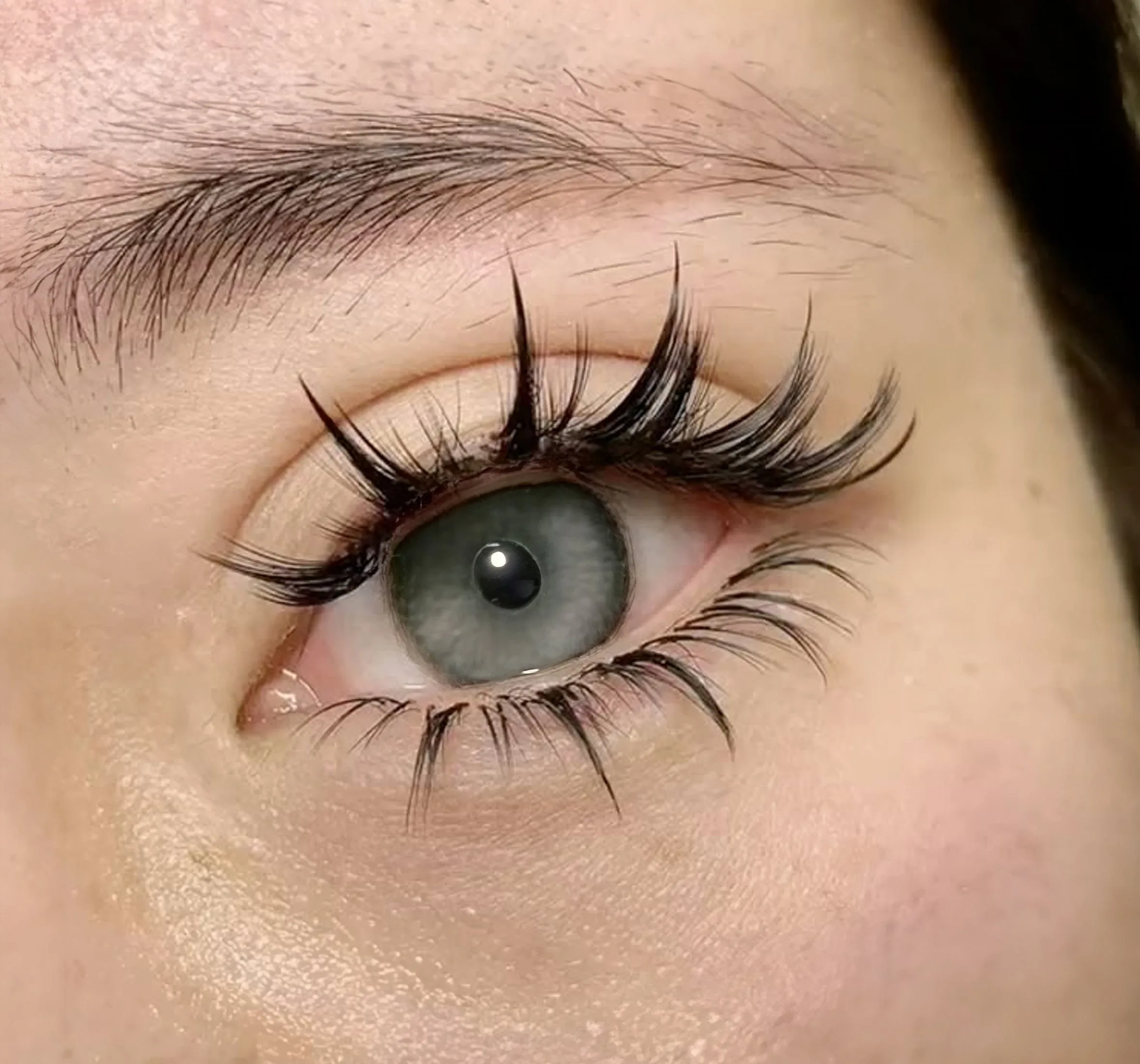
- ShapeWide-set — the eyes are spaced past one eye width apart.
- EffectSquirrel in volume: a dense arch set one zone in from usual.
- Where everyone strugglesDensity drops with the length after the arch. No dark tail.
Why Why it is laid out this way
Density is what makes a squirrel arch look tall without extra length, which is why volume and this spacing get along. The arch sits one zone inboard of its usual place, the two peak zones carry the fullest fans, and past them both length and darkness fall away fast. Hold density flat and you have built a wide band with a bump in it.
The order the zones go on, fan by fan
- Base follows the curveLight fans at every mapped length, short inner start included. The shape lives in the base layer.
- Build density upwardFullness rises step by step alongside length. The eye reads the two rising together as height.
- Peak the arch inboardThe two fullest and longest zones sit over the pupil-to-iris band, one step in from a standard squirrel arch.
- Cut both after peakingLength and fullness drop together in the next zone. Halving one and not the other leaves the map muddled.
- Finish thin outwardShortest and lightest zone last. There is nothing to gain out there and a lot to lose.
The length curve on wide-set eyes
Two zones at full height, then a fall of nearly half, then a fall again — and in volume the density line has to trace the same profile. Darkness reads as size, so a dense outer third rebuilds the width the length curve just removed. The arch should be the brightest thing on the lid and the corner the quietest.
Where does a squirrel map go wrong on wide-set eyes?
Deep The physics underneath
All of this map's material ends up in two zones. Whether they hold is the only mechanical question worth asking.
The same map, built four ways
- Classic 1:1
- Singles would buy the arch's height with length alone and put every unit of it on one lash per position. Worth keeping a few through the fall, where fans look abrupt and singles thin out honestly.
- Handmade volume
- The case for this cell. Fine strands give the arch its darkness for a fraction of the mass a longer single would need, and the inward shift puts that load on lashes better able to carry it.
- Promade / pre-made fans
- Fast across a dense climb, with the node's mass low on the lever. What you lose is the ability to tighten the spread precisely at the peak pair, which is exactly where this map needs it tightest.
- Woven / clover
- Coverage per bond is excellent and the shape repeats. Repetition across a rising climb passes as richness; repetition through the fall turns the drop into a stripe running to the corner.
Spread angle versus weight
Every spread choice compounds at the arch, where the fullest fans and the longest strands sit in the same two zones. A wide fan buys coverage cheaply but hangs its outer legs off the lash's line, and a whole arch of that twist rolls the top over within weeks. Wide through the climb, tight at the peak, minimal past it.
What a wide-set lash line can carry
- Fanning buys darkness for less mass; it does not raise the lash's own limit. The arch's ceiling is still individual mid-lid lashes, and moving it inward is what gives this map a little more of that ceiling to work with.
- Deflection shows before shedding, and here it shows as the top of the arch losing its level. If it has tilted at the two-week check, the fans were too full rather than the map too long.
- The lightest strands in each peak zone set its limit. Two zones share the top, so the weakest lash across both of them decides how long the lift lasts.
Where this map fails first
The outer half of the arch. It holds the map's fullest fans on the shorter, finer end of the mid-lid run, so it reaches its deflection limit first and rolls. Rolling is worse than shedding here, because a rolled fan stops reading as height and starts reading as width — the lift becomes a smear running toward the temple. On this spacing that failure adds apparent distance rather than just fading.
FAQ Common questions
Why does the arch move inward for wide-set eyes?
Because the usual squirrel arch sits near the outer iris, and height that far out reads as extra distance between the eyes. One zone in keeps the lift where it helps.
How full should the arch be?
The fullest part of the set, and no fuller than the two peak zones can hold level. A tilted arch at the first check means back off next time.
Does the tail need any density?
Very little. Short and dark still reads as weight at the far edge, so fullness has to fall with length after the arch.
Volume or hybrid for a wide-set squirrel?
Volume if she wants the arch obvious and will keep her fills; hybrid if she wants texture and a softer fall. The arch position is identical either way.
Print this page or save it as PDF — the diagrams are drawn to stay readable in black and white on plain paper. Or download the diagrams below as SVG. No account, no fee, nothing to sign. Every file carries this page’s address, so wherever it ends up it can be traced back here.
Teaching from these? The offer, and how to credit it.
Also in: Wide-Set eyes · Squirrel / Fox · Volume
Read next: fox eye and squirrel lash mapping, and how they differ · questions clients ask about lash extensions