Almond Eyes · Cat-Eye · Classic 1:1
The cat-eye lash map for almond eyes, built in Classic 1:1 — zone order, where the length peaks, and the point this one usually goes wrong.
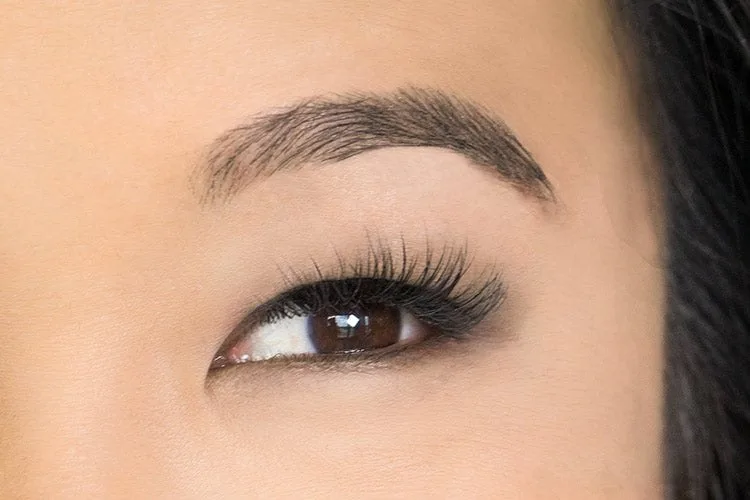
- ShapeAlmond — balanced already, so a cat here is a choice, not a repair.
- EffectCat-eye, one strand on one lash: length climbs right out to the corner.
- Where everyone strugglesEven steps. A late scramble for length shows up as a broken line.
Why Why it is laid out this way
A cat-eye on a balanced lid is pure styling — no droop to fight, no fold to clear. The whole effect rests on one thing: a length climb that never falters between the inner corner and the tail. Classic gives you no fan width to hide an uneven step behind.
The order the zones go in
- Set the inner floorStart the inner corner on your shortest, finest stock. Every zone after it is measured against that floor.
- Climb in equal stepsEach zone one small increment longer than the last, all the way out. The evenness of the steps is the effect.
- Flatten the top two zonesThe final two zones share the longest length rather than ending on a point. A flat top stretches; a single high point pokes.
- Hold one curl familyKeep the same openness across the whole lid. A stronger curl at the tail reads as a wobble in the line.
- Keep the tail fineLongest is not thickest. The outer zones take length only, never extra body.
The length curve on almond eyes
The curve above is a ramp, not a hill. Almond's lid arc rises evenly, so a length line that climbs at a steady rate reads as one continuous lift running past the outer corner — which is what a cat actually is to the eye. The plateau at the end keeps the line from finishing on a spike.
Where does a cat-eye map go wrong on almond eyes?
Deep The physics underneath
The layout is settled above. What follows is why the outer end of this map is the part that argues back.
The same map, built four ways
- Classic 1:1
- One strand per lash means the ramp is only as smooth as your length steps; nothing averages out a bad zone. The two longest zones also sit on the least support anywhere on the lid, so restraint there is the whole skill.
- Handmade volume
- Several fine strands reach the same tail length for less mass than one thick strand — that discount is the reason to build this ramp in volume instead. Without it, a classic cat has to buy its tail length by staying light everywhere else.
- Promade / pre-made fans
- Ready fans speed up the middle zones and land with a small node of mass at the root, which is the cheapest place to carry it. They also arrive with their spread already fixed, and this map wants the spread tightest exactly where it is longest.
- Woven / clover
- Coverage per bond is high, which tempts you toward the thinning corner. The repeat is the trouble: a cat is read as one unbroken line, and an identical unit repeating along it chops that line into blocks.
Spread angle versus weight
Fan width never changes how much mass hangs off a lash, only where that mass sits relative to the lash's own line. On this curve the longest zones are at the corner, where the lid is already turning away from the viewer, so width opened there is width nobody sees. If you build this ramp with fans at all, keep them narrowest at the end and let the middle zones carry the visible density.
What an almond lash line can carry
- The first ceiling is bending, not shedding — once mass and reach together beat a lash's own stiffness, that lash tips down, its zone drops out of the climb, and the map fails while everything is still attached.
- This curve charges for length twice at the same place: the outer zones are both the longest and the furthest reach, so material and leverage rise together on the lashes least equipped for either.
- A zone's ceiling belongs to its thinnest strands, never its average. Outer corners run thin on nearly everyone, which is why a tail length that sat beautifully on one client slumps on the next.
Where this map fails first
The corner, and it is not close. The two longest zones on this map sit on the shortest, finest natural lashes on the lid, right where the eye curves away and the pillow finds it. The first symptom is a slump rather than a gap: the tail tilts down, the ramp loses its top, and the set quietly reads as an everyday map before the client notices anything has gone.
FAQ Common questions
Can you do a cat-eye on almond eyes?
Yes, and almond is one of the easiest shapes for it — there is no droop to fight, so length can climb all the way out. The discipline is in the steps, not the placement.
Where do the longest lashes sit on an almond cat map?
In the last two zones, sharing a single top length. Finishing on one longest point makes the corner look spiked instead of stretched.
Why does my cat-eye look uneven instead of elongated?
Nearly always the steps: several zones held flat, then a big catch-up near the corner. Change length by the same small amount every zone and the line reads as one movement.
Is classic the right technique for a cat map?
It is the honest one. You get a crisp defined edge and no fan width to soften a mis-step, so it shows you very quickly whether your steps are actually even.
Print this page or save it as PDF — the diagrams are drawn to stay readable in black and white on plain paper. Or download the diagrams below as SVG. No account, no fee, nothing to sign. Every file carries this page’s address, so wherever it ends up it can be traced back here.
Teaching from these? The offer, and how to credit it.
Also in: Almond eyes · Cat-Eye · Classic 1:1
Read next: what a cat eye lash map actually is · questions clients ask about lash extensions