Almond Eyes · Cat-Eye · Hybrid
The cat-eye lash map for almond eyes, built in Hybrid — zone order, where the length peaks, and the point this one usually goes wrong.
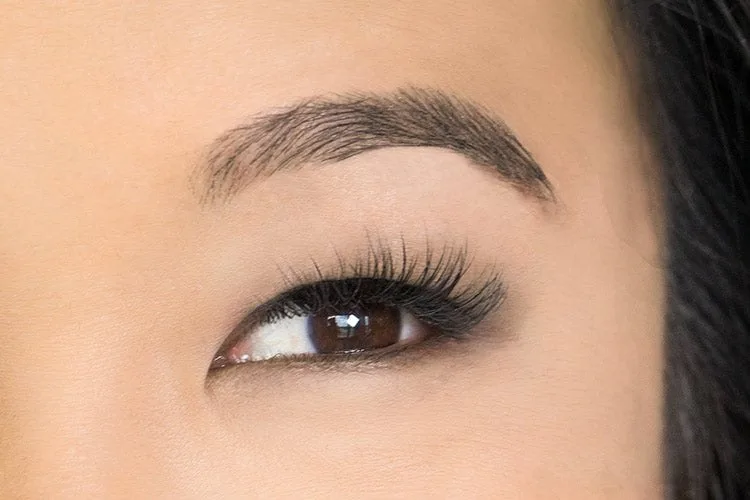
- ShapeAlmond — the lid arc is even, so nothing in this map is doing repair work.
- EffectCat-eye with mixed texture: singles and fans sharing one rising line.
- Where everyone strugglesTexture goes across the whole climb, never dumped at the corner.
Why Why it is laid out this way
Mixing singles and fans on a rising map buys a softer edge than a strict one-on-one cat without the solid darkness of full volume. On a balanced lid the two things compete: every fan is a small interruption in a line whose only job is to rise at a constant rate. Get the rhythm of the mix wrong and the eye stops reading a stretch and starts counting spots.
The order the zones go on, and where the fans land
- Lay the singles firstRun the rising line in single strands from the inner corner outward. That skeleton is the effect — fans are decoration on it.
- Drop fans into the gapsFill between the singles with soft fans cut to the same zone length. Same length, different texture, is the whole trick.
- Hold one mix ratioRoughly the same proportion of fans in every zone. Clustering them makes that section read darker and stalls the climb.
- Keep the outer zones flat-toppedThe last two zones share the top length. No fan is allowed to reach past the singles there.
- Narrow the fans going outFiner, tighter fans toward the corner, where the natural lashes are least able to hold them.
The length curve on almond eyes
The picture above is a straight climb, and the mix has to stay invisible inside it. Almond's arc pushes the line neither up nor down, so any bump the reader sees was put there by your texture and not by the eye. Keeping every fan inside its zone's length is what lets a mixed set still read as one clean rise.
Where does a cat-eye map go wrong on almond eyes?
Deep The physics underneath
Two different objects, one line. What follows is what each costs at the end of this map, where it is longest.
The same map, built four ways
- Classic 1:1
- The singles are this map's spine — they set every zone length and they alone decide whether the climb is even. Each is a whole lash's worth of mass on one anchor, which is precisely why they, not the fans, should carry the tail.
- Handmade volume
- Splitting one strand into several finer ones buys coverage more cheaply than a single of the same visual weight. In this cell, spend that discount inboard where the lashes are strongest and the length demand is lowest.
- Promade / pre-made fans
- The speed is real, and so is the pull toward reaching for one whenever a gap opens near the corner. A ready fan arrives with its spread already decided, and on the outer zones of this map that decision needs to be yours.
- Woven / clover
- One bond, a lot of coverage, and the same silhouette every time. Repeated along a rising line it turns your texture into printed pattern and cancels the reason you went hybrid in the first place.
Spread angle versus weight
Opening a fan adds no mass; it moves the mass sideways off the lash's own line. The widest fans on this map belong in the middle zones, where the lash line faces the viewer squarely and the extra width is actually seen. At the corner the lid turns away, so width bought there earns almost nothing visible and leaves the bond fighting a twist all day.
What an almond lash line can carry
- Bending is the ceiling, not breakage — a lash that gives under load drops out of its zone and the mixed line goes lumpy well before anything sheds.
- Length is charged twice on this curve, because the outer zones are simultaneously the longest and the furthest reach. A fan that behaves perfectly mid-lid is a different proposition three zones later.
- Judge every zone by its weakest strand. In hybrid it is easy to hand the next fan to whichever lash happens to be free, and the free one is usually the youngest and finest in the row.
Where this map fails first
The outer fans go first, and they announce it by turning rather than falling. A fan sitting at top length on a thin corner lash slowly rolls onto its side, so the texture flattens and the mixed edge disappears while the set still looks full from the front. Check the tail for texture at the fill, not for density.
FAQ Common questions
Why pick hybrid for a cat-eye instead of classic?
It gives a softer, less graphic edge and adds density without going to full volume. On almond, where the map is correcting nothing, that texture is often the only thing making the set look designed rather than default.
How should fans and singles be distributed on a cat map?
Evenly, at the same ratio in every zone, with the singles setting all the lengths. Grouping the fans anywhere makes that section read darker and interrupts the rise.
Can the fans be longer than the singles for texture?
Not here. A cat-eye is one continuous rise, so anything poking past its zone reads as a stray — save that idea for a wispy map, where the strays are the point.
Does hybrid last better than volume at the outer corner?
Usually, provided the singles carry the tail and the fans stay inboard. The corner's problem is fine lashes at maximum length, and a single strand there is far easier to keep light than a fan.
Print this page or save it as PDF — the diagrams are drawn to stay readable in black and white on plain paper. Or download the diagrams below as SVG. No account, no fee, nothing to sign. Every file carries this page’s address, so wherever it ends up it can be traced back here.
Teaching from these? The offer, and how to credit it.
Also in: Almond eyes · Cat-Eye · Hybrid
Read next: what a cat eye lash map actually is · questions clients ask about lash extensions