Almond Eyes · Cat-Eye · Volume
The cat-eye lash map for almond eyes, built in Volume — zone order, where the length peaks, and the point this one usually goes wrong.
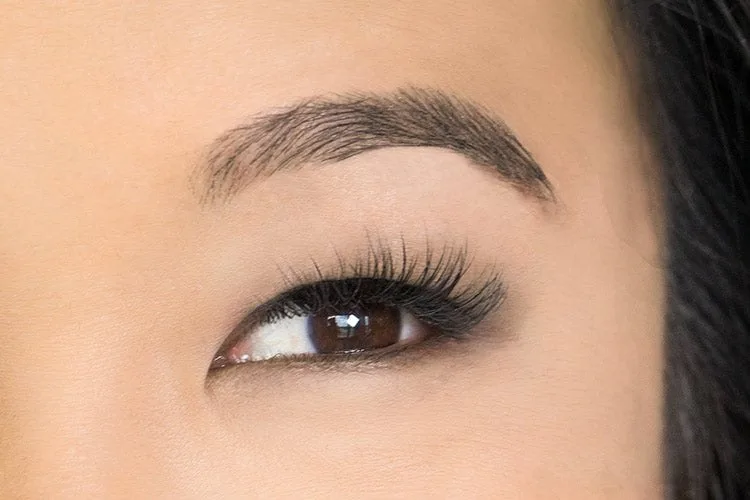
- ShapeAlmond — an even lid, so every zone here is styling rather than fixing.
- EffectCat-eye in fans: the same rising line, built light enough to hold at the tail.
- Where everyone strugglesFullness is not the effect here. If the lengths don't step, nothing else rescues it.
Why Why it is laid out this way
Volume is what makes this map affordable at the far end. A rising line asks for its greatest length exactly where the natural lashes are finest, and several thin strands reach that length for far less mass than one thick one. The risk is the opposite of the classic version: fullness that arrives so evenly it hides the very gradient you were building.
The order the zones go on, fan by fan
- Set the base layer low and shortBuild the whole rising line first as an even base, inner corner to tail. Nothing in this layer overshoots its zone.
- Add the top layer along the same riseThe second layer follows the identical curve, a touch above the base. It runs the full lid, not just the outer end.
- Narrow the fans as length growsWider fans belong in the short inboard zones; the long outer zones get the tightest fans you make.
- Share the top length across two zonesThe last two zones sit level at the maximum. Do not let one fan crown the corner on its own.
- Leave the inner corner airyFewest fans and the shortest lengths here — an overfilled inner corner shortens the eye and cancels the stretch.
The length curve on almond eyes
What the diagram shows is a rate of change, and volume is very good at burying it. Almond's lid gives the line no help and no interference, so the only reason a reader sees elongation is that each zone is measurably longer than the one before. Build the gradient first, then decide how full it gets — never the other way round.
Where does a cat-eye map go wrong on almond eyes?
Deep The physics underneath
A fan is not a discount on length, only on mass. That distinction decides how far this map can reach.
The same map, built four ways
- Classic 1:1
- Single strands make the cleanest edge on a rising line and force you to be honest about steps. What they cannot do is put maximum length on a corner lash without spending a full strand's mass to get there.
- Handmade volume
- The reason this cell works. Coverage falls off far more slowly than mass when you split a strand, so the tail can be as long as the map wants while weighing less than a single would — and you set each fan's width by hand, zone by zone.
- Promade / pre-made fans
- Consistent and quick across a big set, with the bond's extra mass sitting at the root where leverage is smallest. The cost is a fixed width, and this map needs its width to shrink as the length grows.
- Woven / clover
- Excellent coverage per bond, best kept to the short inboard zones. Out at the tail its fixed footprint is both too wide for the lash under it and too repetitive for a line meant to read as one sweep.
Spread angle versus weight
Spread decides the shape of the load, not its size. On this curve the peak zones sit at the outer corner, where the lid is rolling away from the viewer, so a wide fan there presents its width to nobody while still hanging part of its mass off the lash's axis. Keep the visible width in the middle of the lid and let the tail be narrow and long.
What an almond lash line can carry
- The load limit shows up as a lash bending rather than a lash leaving. On a rising map that first bend lands in a top-length zone, and the moment it tips, the climb has no summit.
- Reach costs more than material does. Each step of extra length adds mass and adds the distance that mass works through, which is why the last two zones of this map are worth more scrutiny than the first five put together.
- Fanning does not raise the ceiling of the lash you fan onto — it only lowers what you are asking of it. One fine corner lash is still one anchor, however many strands you land on it.
Where this map fails first
Two places, two mechanisms. Mid-lid the top layer settles into the base and the set loses its dimension while length and density both look fine on camera. At the corner the failure is mechanical: the longest fans on the finest lashes rotate onto their sides, the top of the climb disappears, and what is left slopes gently instead of rising. Neither shows up as shedding at first, which is why clients report it as 'it just stopped looking like a cat'.
FAQ Common questions
Is volume better than classic for a cat-eye on almond?
It is kinder to the outer corner, because the longest zones weigh less for the same look. It is also easier to ruin, since dense fans can flatten the gradient that makes the effect.
How should a volume cat map be layered?
Two layers following the same rising curve across the whole lid, the top one sitting slightly above the base. Starting the second layer partway along puts a visible join in the line.
Should fans be wider at the outer corner for more drama?
No — the opposite. Length is already at its maximum out there on the weakest lashes, so the fans should be at their narrowest and the width should live in the middle zones.
Why does my volume cat look dark rather than long?
Density has overtaken the length steps. Rebuild with the gradient set first and the fullness added afterwards, and keep the inner corner deliberately sparse.
Print this page or save it as PDF — the diagrams are drawn to stay readable in black and white on plain paper. Or download the diagrams below as SVG. No account, no fee, nothing to sign. Every file carries this page’s address, so wherever it ends up it can be traced back here.
Teaching from these? The offer, and how to credit it.
Also in: Almond eyes · Cat-Eye · Volume
Read next: what a cat eye lash map actually is · questions clients ask about lash extensions