Almond Eyes · Doll / Open-Eye · Classic 1:1
The doll lash map for almond eyes, built in Classic 1:1 — zone order, where the length peaks, and the point this one usually goes wrong.
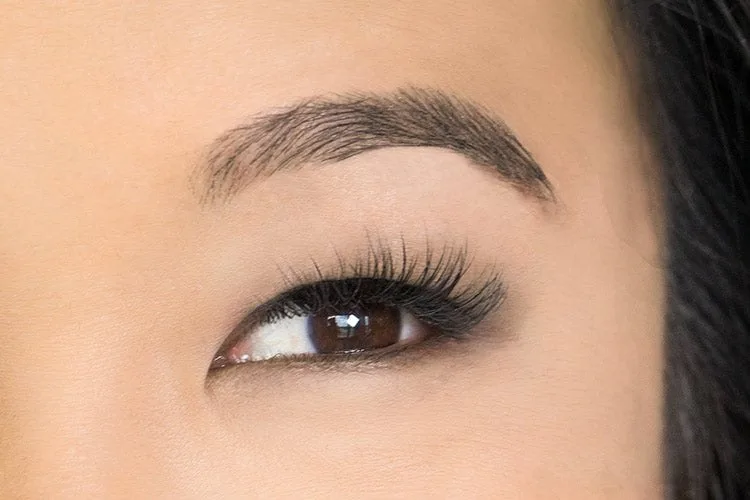
- ShapeAlmond — its own high point sits past centre, so this map moves it forward.
- EffectDoll, one on one: a single peak over the iris with both sides falling equally.
- Where everyone strugglesBoth corners end short. Leave the outer one long and it stops being a doll map.
Why Why it is laid out this way
The doll map sets one high point over the iris and mirrors everything on either side of it, which reads as a rounder, more open eye. On almond that means moving the peak inward from where the lid naturally arcs — the one place this shape's maps deliberately disagree with the shape. Classic keeps the mirror easy to check, because every zone is a countable row of single strands.
The order the zones go in
- Mark the iris, not the midpointHave her look straight ahead and find where the iris sits. That point, not the middle of the lash line, is the peak.
- Build up to the peak quicklyTwo brisk steps from the inner corner to the top length. The rise has to be steep or the eye reads as long rather than open.
- Mirror the fallCome down at exactly the rate you went up, zone for zone. Symmetry is the effect, so an error either side is worth double.
- Drop both corners the sameInner and outer finish at the same short length. An outer corner left long turns this into a different map entirely.
- Check it with her eyes openSit her up and look at both eyes together. A mirror that holds on a closed lid can still be out by a zone when she opens them.
The length curve on almond eyes
The curve above is a symmetrical hill, and its centre is not where an almond lid peaks on its own. Pulling the high point forward over the iris is exactly what widens the eye — the same length, half a zone further in, turns long into open. Both sides then have to fall at the same rate, or the symmetry carrying the effect falls apart.
Where does a doll map go wrong on almond eyes?
Deep The physics underneath
Mid-lid is the strongest ground on the eye. This map spends nearly everything there and almost nothing at the edges.
The same map, built four ways
- Classic 1:1
- One strand per lash makes the mirror auditable — count the zones down each side and an error is obvious. It also puts a row of full-mass singles at the peak, which only works because mid-lid lashes are the sturdiest on the eye.
- Handmade volume
- Fans reach the same central height for less mass, useful when her strongest zone still isn't strong. They soften the steep sides though, so the symmetry has to be checked by length rather than by how full each side looks.
- Promade / pre-made fans
- Quick through the two central zones where this map does most of its work. Their fixed spread turns into a nuisance at the corners, which want to be short and unnoticeable.
- Woven / clover
- A repeating unit does least damage on a symmetrical map, since the eye is already reading side against side. Keep it out of the peak all the same — the top of this curve needs a clean outline, not a texture.
Spread angle versus weight
Widening a fan moves mass sideways without adding any, and on a centre-peaked map that width lands where the lid faces the viewer most squarely. So this is the one map where spread is fully visible, which is both a licence and a trap: the widest fans look best exactly where the workload is highest. Open them no further than it takes to reach the neighbouring lash.
What an almond lash line can carry
- Overload here shows as a sinking peak rather than a bare patch — the centre zone bends, the hill flattens, and the eye stops looking open while every extension is still attached.
- Length is a smaller ask at the centre than anywhere else on the lid, because the lashes under it are the thickest and stiffest on the eye. That is why this map tolerates a top length a corner-weighted map could not carry.
- The peak zone's real limit belongs to its youngest, finest hairs, and mid-lid always holds a few. Build for those and the zone holds its shape as it turns over.
Where this map fails first
The centre, and unevenly. Mid-lid lashes are strong enough that this map rarely collapses from load; what breaks is the mirror, when one side of the peak sheds slightly faster than the other. A lopsided doll looks worse than a flat one, because symmetry was the entire effect. At the fill, rebuild both sides of the peak rather than patching the thin one.
FAQ Common questions
Does a doll map suit almond eyes?
It suits them mechanically and changes them deliberately. Almond needs no correction, so this map is a styling decision: it rounds and opens an eye whose natural read is long.
Where exactly does the peak go?
Over the iris with her looking straight ahead, which is usually a little inside the midpoint of the lash line. Measuring from the corners instead is the most common way this map ends up looking like something else.
Why do my doll sets look uneven between the two eyes?
Because a symmetrical map has twice the surface for a mistake to show on. Count zones from the iris outward on both eyes rather than working corner-first, and check them sitting up.
Doll or an everyday map on almond — how do I choose?
Ask what she wants more of. A doll map buys width and openness at the cost of the eye's long line; if she likes that line, this is not her map.
Print this page or save it as PDF — the diagrams are drawn to stay readable in black and white on plain paper. Or download the diagrams below as SVG. No account, no fee, nothing to sign. Every file carries this page’s address, so wherever it ends up it can be traced back here.
Teaching from these? The offer, and how to credit it.
Also in: Almond eyes · Doll / Open-Eye · Classic 1:1
Read next: open eye versus doll — one family, two intents · questions clients ask about lash extensions