Almond Eyes · Doll / Open-Eye · Hybrid
The doll lash map for almond eyes, built in Hybrid — zone order, where the length peaks, and the point this one usually goes wrong.
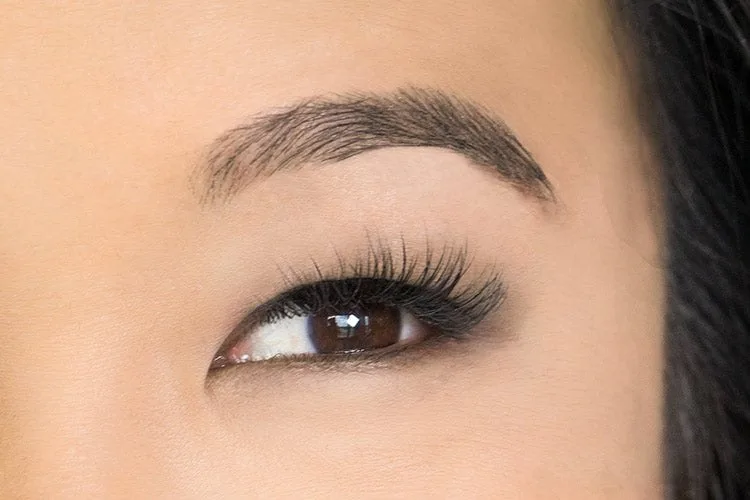
- ShapeAlmond — even lid, natural high point past centre, nothing needing correction.
- EffectDoll in mixed texture: a centre peak with fans woven through the singles.
- Where everyone strugglesTexture has to be mirrored. Scatter it freely and the symmetry disappears.
Why Why it is laid out this way
Texture and symmetry pull against each other, and this map needs both. The doll effect is read by comparing one side of the peak with the other, so any fan you place on the left is a question about the right. Hybrid works here only if the mix is placed deliberately instead of wherever the tweezers land.
The order the zones go on, and where the fans land
- Draw the hill in singlesSingle strands set every zone length, rising fast to the iris and falling the same way. This is the shape the client sees.
- Mirror every fan you placeWork matching zones on both sides of the peak. If one side gets a fan, its partner zone gets one too.
- Keep the fans inside their zoneNo fan reaches past the singles beside it. Texture here is a change of density, not a change of outline.
- Leave both corners plainThe short end zones stay in singles. A fan on a very short corner lash reads as a stray hair, not as texture.
- Audit side against sideStep back with her eyes open and compare halves, not corners. A hybrid doll fails as an imbalance long before it fails as a length.
The length curve on almond eyes
The picture above is a hill with two matching slopes, and mixed texture is very good at hiding which slope is which. Because almond's lid arcs evenly, nothing in her anatomy will flag a lopsided set for you — the map has no built-in reference to check against. Put the mix in matched pairs and the mirror survives the texture.
Where does a doll map go wrong on almond eyes?
Deep The physics underneath
Everything above is placement. Below is why the two slopes, not the peak, decide how long this set keeps working.
The same map, built four ways
- Classic 1:1
- The singles hold the outline and make the two slopes measurable against each other. On this map they should also own both corners, where a fan has nothing worth doing.
- Handmade volume
- Hand-built fans let you match width side to side, which is the only way texture and symmetry coexist here. Spend them on the slopes, where a little extra density reads as roundness.
- Promade / pre-made fans
- Their consistency is genuinely useful on a mirrored map — two identical fans in partner zones cost no thought. Their fixed width is the catch, since the slopes want a slightly different fan from the peak.
- Woven / clover
- The repeat that spoils a swept line is less obvious on a symmetrical one. Even so, keep it off the peak zone: the top of this curve is meant to be a single clean point, not a motif.
Spread angle versus weight
A fan's spread changes the footprint of its mass, never the amount. The peak of this map faces the viewer head-on, so width there is fully visible and fully tempting — and it is also the zone already carrying the longest strands. Put your wider fans a zone either side of the top, where they build the roundness without adding to the load at the summit.
What an almond lash line can carry
- The ceiling arrives as bending: a mid-lid lash gives, its fan tips forward, and the slope it belonged to loses definition while the set still counts as full.
- Every step of extra length adds both material and the distance that material acts through, so the peak zone is the only place on this map worth arguing about. The corners are so short that they are effectively free.
- A zone can only carry what its weakest hairs can carry. On a mirrored map that matters twice over, because one weak zone does not just thin — it makes the whole eye look crooked.
Where this map fails first
The slopes go before the peak does. Mid-lid lashes hold the top length well, but the zones either side turn over at their own pace, and as fans thin out of one flank the hill stops being a hill and starts being a lump. Because both sides never shed at the same rate, the first thing the client notices is that one eye looks different from the other. Fill by comparing halves rather than by hunting gaps.
FAQ Common questions
Can you add texture to a doll map without ruining it?
Yes, if the texture is mirrored. Place fans in matching zones on both sides of the peak and keep them inside their zone's length, and the outline stays symmetrical.
Should the fans be longest at the peak?
They should be no longer than the singles in the same zone. Crowding extra reach onto the top flattens it into a table and the open-eye read goes with it.
Why does my hybrid doll set look off-centre?
Usually density rather than length. The eye locates a peak partly by where the darkest part of the line sits, so an unmatched cluster of fans moves the apparent peak even when the lengths are perfect.
Do the corners need texture too?
No. They are the shortest, finest zones on the map, and a fan there reads as an accident rather than as a wisp — leave both ends in plain singles.
Print this page or save it as PDF — the diagrams are drawn to stay readable in black and white on plain paper. Or download the diagrams below as SVG. No account, no fee, nothing to sign. Every file carries this page’s address, so wherever it ends up it can be traced back here.
Teaching from these? The offer, and how to credit it.
Also in: Almond eyes · Doll / Open-Eye · Hybrid
Read next: open eye versus doll — one family, two intents · questions clients ask about lash extensions