Almond Eyes · Doll / Open-Eye · Volume
The doll lash map for almond eyes, built in Volume — zone order, where the length peaks, and the point this one usually goes wrong.
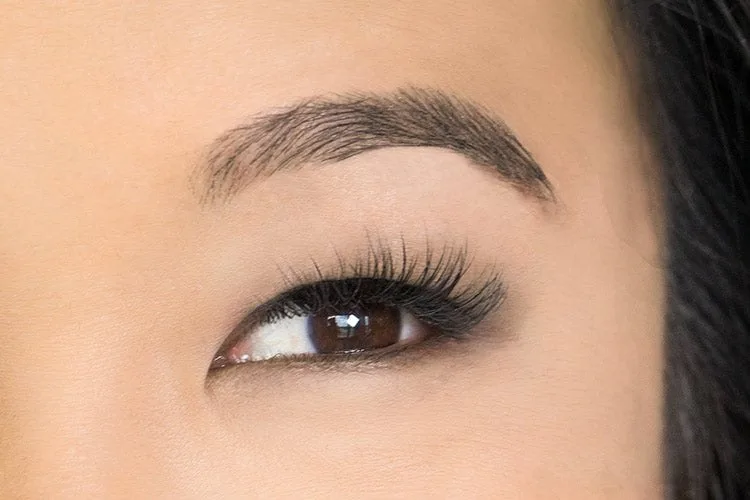
- ShapeAlmond — balanced arc, so a centre peak is styling and not a fix.
- EffectDoll in fans: one high point over the iris, layered, with both ends short.
- Where everyone strugglesA dark solid line makes an eye look smaller. Openness needs air in it.
Why Why it is laid out this way
Height opens an eye and darkness shrinks it, which is the whole tension in a volume doll set. The map wants its longest fans over the iris and its density kept honest, because a lash line packed solid at the centre reads as a heavy band rather than a wide eye. Layering is what buys the height without paying for it in weight.
The order the zones go on, fan by fan
- Base layer follows the hillBuild the whole symmetrical curve first in a light base, corner to corner. Get the shape right before adding anything.
- Top layer shares the same peakThe second layer echoes the base zone for zone, high point in the same place. Two layers, one summit.
- Leave air at the centreKeep visible gaps between the peak fans. Fullness at the top closes the eye that the length just opened.
- Widen on the slopes, not the summitThe zones either side carry the roundness, so give them the width and keep the peak fans tight.
- Finish both corners short and fineNarrow fans, shortest lengths, both ends alike. Corners are where volume habits do the most damage to this map.
The length curve on almond eyes
The diagram is a steep symmetrical hill, and volume can build it or bury it. Almond's lid does nothing to help — the eye only looks rounder because one central zone stands clearly above its neighbours, so anything that lifts the neighbours reduces the effect. Height at the middle, restraint at the sides, is the entire instruction.
Where does a doll map go wrong on almond eyes?
Deep The physics underneath
Fans buy coverage cheaply and height expensively. This map spends the whole budget on one central zone, so that is the zone to reason about.
The same map, built four ways
- Classic 1:1
- The clearest way to build this hill and the heaviest, since every bit of central height costs a full strand. It stays the better option when her mid-lid lashes are strong and she wants a crisp, uncrowded edge.
- Handmade volume
- What this cell is for: the peak reaches its length in several fine strands, so the summit is tall without being dense. It also lets you tune width zone by zone, which is how the slopes get their roundness.
- Promade / pre-made fans
- Speed across a symmetrical map, and partner zones can be matched without thinking. The fixed spread fights you at the two corners, which want the narrowest, quietest fans on the set.
- Woven / clover
- Coverage per bond is high and the pattern repeat is least visible on a mirrored map. Keep it on the slopes: the peak needs a clean outline and some daylight through it.
Spread angle versus weight
Opening a fan redistributes mass sideways rather than adding to it, and on this map the peak faces the viewer square-on, so every degree of spread shows. That is exactly why it needs limiting there — width at the summit fills the gaps that make the eye look open, and it hangs part of each fan off its lash's own line. Spread on the slopes, height at the top.
What an almond lash line can carry
- The load ceiling shows up as a bend, and on this map a bent peak is fatal: the tallest zone drops level with its neighbours and the eye closes back to where it started.
- Mid-lid lashes are the stiffest on the eye, so the central zone can take more length than any corner could — but it is also the only zone where this map has any length worth carrying.
- The zone's limit is set by its finest hairs, not the strong ones that catch your eye first. Fanning lowers what each lash is asked to hold; it does not change how much any of them can.
Where this map fails first
The centre fails, and it does it twice over. Mechanically the tallest fans sink first, because that is where the length is; visually the set gets denser as fills add fans faster than the peak regrows, so the line darkens while it flattens. Both changes push the same way — an eye that looked wide open at handover looks merely full six weeks later. Fill by re-establishing the height and taking density out, not by adding more.
FAQ Common questions
Why does my volume doll set make the eye look smaller?
Almost always density. An open-eye read depends on light passing through the lash line, so a solid dark centre works directly against the height you built.
How many layers should a doll map have?
Two is plenty: a light base carrying the whole curve, and a top layer peaking in the same zone. A third layer adds weight in the one place that can least spare the extra.
Where do the widest fans belong on a doll map?
On the slopes either side of the peak. They build the roundness there, whereas at the summit width fills the gaps that make the eye look open.
Is volume or classic better for a doll map on almond?
Volume if her central lashes are fine or she wants obvious fullness, classic if she wants a defined edge. The map itself is identical — only the cost of the peak changes.
Print this page or save it as PDF — the diagrams are drawn to stay readable in black and white on plain paper. Or download the diagrams below as SVG. No account, no fee, nothing to sign. Every file carries this page’s address, so wherever it ends up it can be traced back here.
Teaching from these? The offer, and how to credit it.
Also in: Almond eyes · Doll / Open-Eye · Volume
Read next: open eye versus doll — one family, two intents · questions clients ask about lash extensions