Almond Eyes · Natural · Classic 1:1
The natural lash map for almond eyes, built in Classic 1:1 — zone order, where the length peaks, and the point this one usually goes wrong.
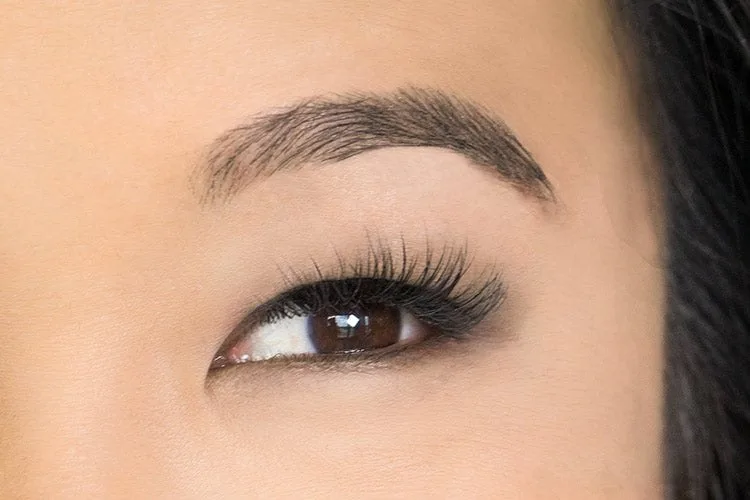
- ShapeAlmond — already balanced, so this map corrects nothing.
- EffectNatural, one-on-one: a single soft peak just past the middle.
- Where everyone strugglesNo big jumps. Step the length down a hair at a time, both ways.
Why Why it is laid out this way
Almond is the shape every other map is measured against. A natural classic set is the plainest thing you can build on it — one lash on one lash, no fans, no correction. Nothing hides a mistake, which is exactly why it teaches length control.
The order the zones go in
- Anchor one peakLongest zone a touch past the middle, under the high point of the arc. One peak — resist a second.
- Walk length down both waysStep shorter toward the inner corner, slower toward the outer. A hair per zone.
- Hold one curl familyOne soft open curl across the whole lid. Switching curl mid-lid shows instantly.
- Keep the inner corner honestInnermost lashes stay the shortest and finest. Overloading them kills the natural read.
The length curve on almond eyes
A natural set works by staying inside the eye's own geometry. The almond lid peaks past centre and tapers to both corners, so a map that echoes that curve disappears into the lash line. Break the gradient in one zone and it reads as a diagram, not lashes.
Where does a natural map go wrong on almond eyes?
Deep The physics underneath
Everything above is layout. This is what the layout negotiates with: one strand, one follicle, one lever.
The same map, built four ways
- Classic 1:1
- Load is a sum of single strands, each on its own anchor — the most predictable and least forgiving. Fuller means thicker, and mass rises with the square of diameter. Fullness here is bought with weight.
- Handmade volume
- Fine strands fanned on one lash. Mass falls with the square of diameter but coverage only in proportion — halve the diameter, double the count, same width at half the mass. That discount is its whole licence.
- Promade / pre-made fans
- The bond node adds a little mass at the root — the cheapest spot on the lever — and buys consistency. It removes your control of the spread on the lid.
- Woven / clover
- Great coverage per bond, but a spread that repeats identically reads as pattern. On the plainest map in the library, pattern is the one thing it can't have.
Spread angle versus weight
Spread doesn't change how much mass is on the lash — only where it sits. Open a fan and the mass moves off the lash's axis, so it carries a twist and rotates to relieve it. On a natural map, run the narrowest spread that still closes the gap to the next lash.
What an almond lash line can carry
- Deflection is the first ceiling, not shedding: once the extension's mass × lever beats the lash's stiffness, that lash sits low and the gradient stops reading — 'wrong' before anything falls off.
- Length punishes twice — heavier and further out on the lever at once. An extension should be a fraction of the lash's mass, only modestly longer, never a multiple of either.
- A zone is not uniform. Its lightest strands set its real ceiling, not the average — which is why the same spec fails on a sparse client.
Where this map fails first
Two edges, two reasons. The inner corner carries the finest lashes and is where the client's own eye lands — droop shows there first. The outer tail fails mechanically: the lid curves away, the bond wraps less, and it takes the pillow and the towel. Map the tail so the shape holds as it thins.
FAQ Common questions
Is a natural classic set the right first map on almond eyes?
Yes. Almond needs no correction, classic 1:1 removes fan variables, and the natural effect hides nothing — so it teaches length control faster than any other cell.
How do you keep a natural set from looking flat?
The single soft peak past centre does it. Flatness comes from one length across the lid; a gentle rise-and-fall around one peak gives dimension without reading as a style.
Should the inner and outer corners taper the same?
No. The inner taper is quicker and ends shorter; the outer taper is slower, keeping a hint of length at the tail without a lifted look.
Print this page or save it as PDF — the diagrams are drawn to stay readable in black and white on plain paper. Or download the diagrams below as SVG. No account, no fee, nothing to sign. Every file carries this page’s address, so wherever it ends up it can be traced back here.
Teaching from these? The offer, and how to credit it.
Also in: Almond eyes · Natural · Classic 1:1
Read next: questions clients ask about lash extensions