Almond Eyes · Natural · Hybrid
The natural lash map for almond eyes, built in Hybrid — zone order, where the length peaks, and the point this one usually goes wrong.
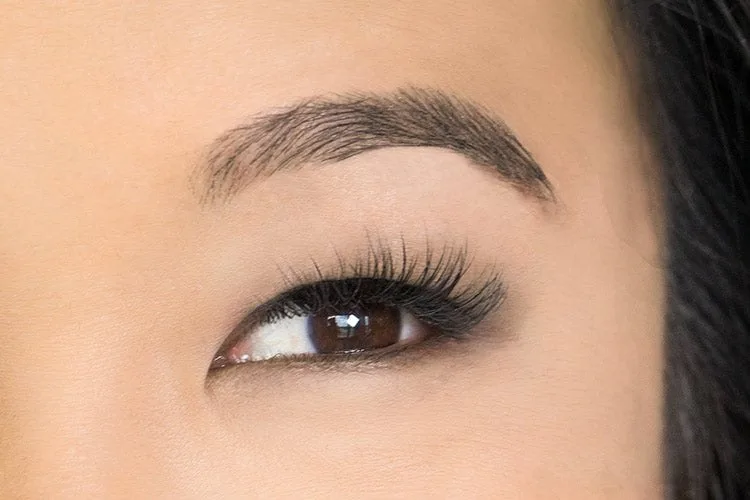
- ShapeAlmond — an even arc, so this map follows the eye instead of arguing with it.
- EffectNatural with mixed texture: soft fans among singles, no change to the outline.
- Where everyone strugglesFans match the length of the singles beside them. Texture is density, not outline.
Why Why it is laid out this way
Hybrid is usually chosen because texture shows, and a natural map is chosen because nothing shows — this cell is the place those two ideas have to be reconciled. The fix is to let the mix work on fullness only and leave the silhouette exactly where a plain map would put it. Done properly it looks like a good lash day, not a set.
The order the zones go on, and where the fans land
- Run the singles across firstSet every zone length in single strands, inner corner to tail. The outline is finished before any fan goes on.
- Hold the top across two zonesThe longest length runs over a pair of zones just past centre, not a single high point. That flat stretch is what keeps it looking unplanned.
- Match each fan to its neighbourEvery fan is cut to the same length as the singles around it. Nothing reaches past the line you already drew.
- Break up the rhythmVary where the fans fall rather than placing one every few lashes. Regular spacing is what makes a mix look manufactured.
- Taper faster on the insideThe inner corner comes down further and quicker than the tail, which keeps some softness at the outer end.
The length curve on almond eyes
The line above rises gently, sits level for two zones, then eases off — that is close to what the lid does on its own. Almond arcs evenly and peaks a little past the middle, so a curve that copies it has no visible start or finish. Texture is allowed to change how full that line looks, never where it goes.
Where does a natural map go wrong on almond eyes?
Deep The physics underneath
Two kinds of object on one quiet line. What follows is what each one costs where the map runs longest.
The same map, built four ways
- Classic 1:1
- The singles here are the map — they fix the lengths and hold the level top. Each carries a full strand's mass on one lash, which is why they, not the fans, should sit in the two longest zones.
- Handmade volume
- A hand-built fan reaches the same length as a single for less mass, so it is the safest way to add fullness to a line that must stay light. Keep the width small enough that the fan still reads as one soft mark.
- Promade / pre-made fans
- Quick and identical, and identical is the risk on this cell — a natural read depends on small inconsistencies. Use them for density in the mid zones and vary what sits between them.
- Woven / clover
- The most coverage per bond and the most repetition, which is a poor trade on a map whose whole claim is that nobody planned it. If you use it at all, break it up with singles so no two identical marks sit together.
Spread angle versus weight
Spread moves a fan's mass sideways; it never reduces it. Across the level top of this map the lid faces the viewer squarely, so even a modest width is visible there, and visible width is what turns a soft line into a strip. Keep the fans just wide enough to touch the gap they are closing, and no wider.
What an almond lash line can carry
- The first thing to go is posture, not attachment: a lash loaded past its stiffness tips forward, sits below its neighbours, and the gentle curve above develops a dent nobody can name.
- Length charges twice, adding both material and the reach that material works through — which is why the two top zones of this map are the only ones where a fan's width is worth arguing about.
- Read a zone by its weakest hairs. In a mixed set the fan tends to go wherever there is a free lash, and free lashes are often the newest and finest in the row.
Where this map fails first
The two longest zones fail together, but rarely at the same rate. One of the pair thins first, the level top tilts, and what was a soft arc turns into a slope with a corner in it. Because nothing here is dramatic to begin with, clients describe this as the set looking tired rather than as anything having fallen out. Fill the pair as a unit and the map goes back to being invisible.
FAQ Common questions
Does texture belong on a natural map at all?
Only as density. Fans placed at the same length as the singles beside them add softness and fullness without changing the outline, and the outline is what makes a set look natural.
Why do my hybrid natural sets look busy?
Two usual causes: fans cut longer than their neighbours, and fans placed at regular intervals. Match the lengths and scatter the placement and the busyness goes.
Should the top be one peak or two zones?
Two, on this map. A single high point past centre is legible as a decision, whereas a top length running across a pair of zones reads as the eye's own shape.
Is hybrid or classic better for a first natural set?
Classic, while you are learning the length steps. Hybrid adds a second variable, and on a map this quiet the mistake shows up as vague untidiness rather than anything you can point at.
Print this page or save it as PDF — the diagrams are drawn to stay readable in black and white on plain paper. Or download the diagrams below as SVG. No account, no fee, nothing to sign. Every file carries this page’s address, so wherever it ends up it can be traced back here.
Teaching from these? The offer, and how to credit it.
Also in: Almond eyes · Natural · Hybrid
Read next: questions clients ask about lash extensions