Almond Eyes · Natural · Volume
The natural lash map for almond eyes, built in Volume — zone order, where the length peaks, and the point this one usually goes wrong.
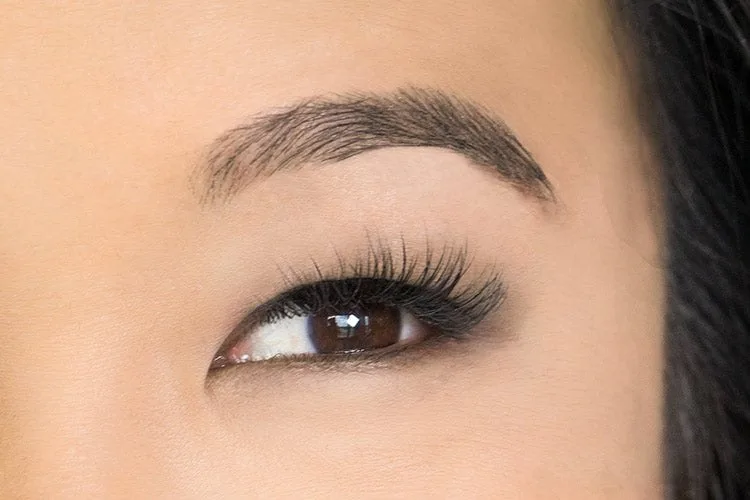
- ShapeAlmond — the lid arcs evenly, so the map copies it rather than correcting it.
- EffectNatural in fans: fullness for a sparse line, with the same quiet outline.
- Where everyone strugglesFans here buy coverage, not height. The moment the line goes dark it stops being natural.
Why Why it is laid out this way
Most clients who ask for natural volume are asking for a gap problem to be solved, not for a bigger look. Fans let you close those gaps with far less weight than singles of the same visual thickness, which is the only reason this combination exists. Everything else about the map stays as plain as it would be with one strand per lash.
The order the zones go on, fan by fan
- Keep fans narrow throughoutEnough strands to fill a gap, no more. A narrow fan reads as one soft lash; a wide one reads as a set.
- Copy the gentle curveEase up to the top length, hold it over two zones just past centre, then ease down. No zone jumps.
- Fill gaps, don't stackWork along the line closing spaces rather than building a second storey. Depth is what makes volume obvious.
- Let the tail come down slowlyThe outer end tapers gradually and keeps some length, while the inner corner falls away much faster.
- Leave the inner corner sparseShortest, narrowest fans, and skip the finest lashes altogether. Nothing about a natural read survives a crowded inner corner.
The length curve on almond eyes
The curve above is deliberately unremarkable, and density is the thing most likely to erase it. Because almond's arc gives the map no lift of its own, the shape is only visible as a difference between neighbouring zones — fill every zone to the same height and there is nothing left to see. Note the two ends: the inner drops away sharply, the tail only eases, and that mismatch is what stops the eye looking round.
Where does a natural map go wrong on almond eyes?
Deep The physics underneath
Volume's real currency is coverage per unit of mass. On this map the whole discount goes into filling gaps, and none of it into reach.
The same map, built four ways
- Classic 1:1
- One strand per lash gives the cleanest quiet line and the least room to hide, but it can only fill a gap by getting thicker. On a sparse client that is precisely the wrong currency.
- Handmade volume
- The point of this cell: split the same material into finer strands and you cover more line for less mass, gap by gap. Because you build each fan yourself, the width can stay small in the zones where the lashes are finest.
- Promade / pre-made fans
- Consistent, quick, and slightly heavier at the root where the node sits — the least expensive place to carry mass. The uniformity is the catch here, since a natural read leans on small differences from lash to lash.
- Woven / clover
- Strong coverage from a single bond, which sounds ideal for a sparse line. The identical footprint repeating along the lid is the problem: it fills the gaps and puts a visible rhythm in a map that should have none.
Spread angle versus weight
Spread is a choice about footprint, not about load — the mass is the same however far you open it. Across the two level zones past centre, the lid is turned toward the viewer and any width you open there is fully on show, which is where a natural set most easily tips into looking dense. Open a fan only as far as the gap it is closing.
What an almond lash line can carry
- Bending sets the limit before shedding does: a lash that gives under its fan drops below the line, and on a map this gentle a single dropped lash is a visible flaw in the curve.
- Extra length costs both weight and reach at once, so on this map the safest place for length is the pair of top zones sitting on strong mid-lid lashes — and the least safe is anywhere near the inner corner.
- Each zone is only as strong as its thinnest hairs, and a volume set on a sparse line runs out of thick ones fast. If a lash would not hold a single strand, it will not hold a fan of the same length.
Where this map fails first
The inner corner goes before anything else, because that is where a volume habit meets the finest lashes on the eye. Fans get placed there to close the last few gaps, the lashes underneath are short and young, and within a fortnight they are lying flat or gone. The set does not look sparse when this happens — it looks slightly grubby at the inside of the eye, which clients notice in the mirror long before they notice length. Leave that zone deliberately underfilled and the whole map ages better.
FAQ Common questions
Is natural volume a contradiction?
No, but the reason has to be coverage. Fans close gaps at less weight than thicker singles would, so a sparse lash line can look full while the map stays as plain as ever.
How wide should the fans be on a natural map?
Only as wide as the gap beside them. Width is the single thing that turns a soft line into a dark one, and darkness is what clients mean when they say a set looks fake.
Should a natural volume set be layered?
Better not. Depth reads as construction, and this map is trying to look like nothing was constructed — work along the line closing spaces instead of stacking above it.
Why does the outer end stay longer than the inner corner?
Because a symmetrical taper rounds the eye. Dropping the tail as fast as the inner corner shortens the line and turns a natural almond map into a mild open-eye one.
Print this page or save it as PDF — the diagrams are drawn to stay readable in black and white on plain paper. Or download the diagrams below as SVG. No account, no fee, nothing to sign. Every file carries this page’s address, so wherever it ends up it can be traced back here.
Teaching from these? The offer, and how to credit it.
Also in: Almond eyes · Natural · Volume
Read next: questions clients ask about lash extensions