Almond Eyes · Squirrel / Fox · Classic 1:1
The squirrel lash map for almond eyes, built in Classic 1:1 — zone order, where the length peaks, and the point this one usually goes wrong.
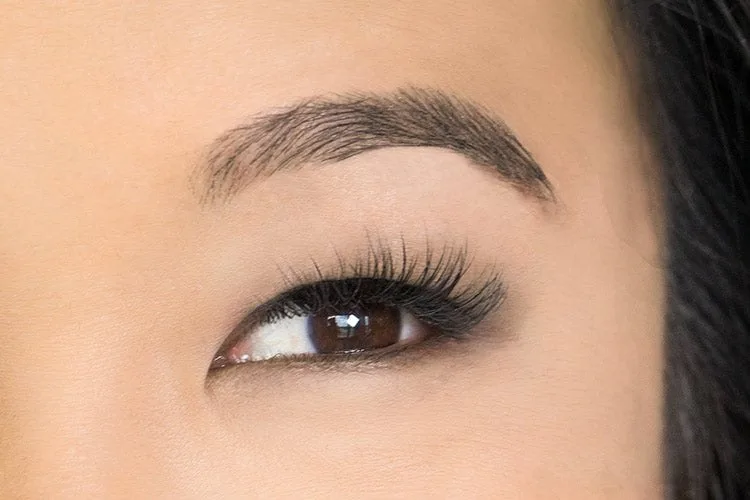
- ShapeAlmond — no correction needed, so the peak is placed by choice alone.
- EffectSquirrel, one on one: the high point sits about two-thirds along, then falls.
- Where everyone strugglesThe peak is not the corner. Slide it out to the end and you have built a cat.
Why Why it is laid out this way
Squirrel and cat are often confused, and on a balanced eye the difference is one zone and one decision: does the length come back down after the high point, or not? This map peaks under the brow arch and then tapers to a tail that still carries a bit of length. That descent is the effect, so the last two zones matter as much as the peak does.
The order the zones go in
- Keep the inner third quietShort, fine, unremarkable for the first three zones. All the interest in this map lives past the middle.
- Take the climb in stepsThe biggest length change on the map sits between the middle and the peak. Split it across zones rather than doing it in one move.
- Put the peak under the archLongest zone roughly two-thirds of the way out, below the high point of the brow. Not at the corner.
- Come back down after itStep the length down again past the peak, at about the rate you came up. A squirrel that never descends is a cat.
- Leave the tail mid-lengthThe outer corner ends shorter than the peak but longer than the inner corner. It should not vanish.
The length curve on almond eyes
The line above rises quietly, jumps once, and comes back down — and that single climb is where the map succeeds or fails. Almond's own arc has begun to fall by the time this peak arrives, so the map is borrowing lift the lid is no longer giving, which is exactly what makes the eye look longer without loading the corner. Bring the tail down after it and the length reads as a lift rather than a stretch.
Where does a squirrel map go wrong on almond eyes?
Deep The physics underneath
The peak on this map sits where the lash line is already past its best. That single fact drives everything below.
The same map, built four ways
- Classic 1:1
- Every zone is one strand on one lash, so the climb into the peak is visible in full detail and so is any zone you got wrong. It also puts the map's two longest zones on outer-third lashes with no weight-sharing of any kind.
- Handmade volume
- Fine strands fanned together reach the peak length for a fraction of a single's mass, which is the standard argument for building this shape in volume. In classic you forgo that, so the peak length has to be modest enough for the lashes actually under it.
- Promade / pre-made fans
- Consistent and fast through the quiet inner zones where nothing much is happening. Around the peak their fixed spread stops you tapering the width as the length rises, which is the one adjustment this map really wants.
- Woven / clover
- Plenty of coverage per bond, and a repeat that is most obvious on the descent after the peak, where the eye is following a change. Keep it inboard if you use it at all.
Spread angle versus weight
Fan spread decides where the mass sits relative to the lash, not how much of it there is. This map's peak sits on the part of the lid already curving away from the viewer, so a wide fan there is showing its width to the side of her face rather than the front. The visible density belongs in the middle zones; the peak wants narrow and tall.
What an almond lash line can carry
- The ceiling announces itself as a droop, not a gap — the peak zone bends under its own length, drops level with its neighbours, and the lift the client paid for is gone while the set still looks complete.
- Length is charged twice: more material and more reach, both landing on the outer third, where lashes are naturally finer than they were three zones earlier.
- The weakest hairs in the peak zone set its limit, not the average. Two clients with the same brow can take very different peak lengths, and the only way to know is to look at what is under it.
Where this map fails first
The peak, because it is the longest thing on the lid sitting on lashes that have already started to thin. As those turn over the high point flattens, and what is left is a slow rise into a middling tail — a set that reads as neither one effect nor the other. Clients rarely report it as thinning; they say it has stopped looking lifted. Fill the peak zone and the zone before it first, and let the inner corner wait.
FAQ Common questions
What is the difference between a squirrel map and a cat map?
Where the length ends. Both build outward, but a squirrel peaks under the brow arch and then steps back down, while a cat carries its longest length all the way to the corner.
How far along should the peak sit?
Roughly two-thirds of the way from the inner corner, under the high point of the brow. Closer than that and it reads as an everyday map; further and it turns into a cat.
Why does my squirrel map look broken in the middle?
Because the biggest length change on this map happens just before the peak, and it usually gets taken in one jump. Spread it across two zones and the climb reads as a curve.
Should the outer corner be as short as the inner one?
No. The tail comes down from the peak but stays longer than the inner corner — cutting it right back rounds the eye and cancels the lift.
Print this page or save it as PDF — the diagrams are drawn to stay readable in black and white on plain paper. Or download the diagrams below as SVG. No account, no fee, nothing to sign. Every file carries this page’s address, so wherever it ends up it can be traced back here.
Teaching from these? The offer, and how to credit it.
Also in: Almond eyes · Squirrel / Fox · Classic 1:1
Read next: fox eye and squirrel lash mapping, and how they differ · questions clients ask about lash extensions