Almond Eyes · Squirrel / Fox · Hybrid
The squirrel lash map for almond eyes, built in Hybrid — zone order, where the length peaks, and the point this one usually goes wrong.
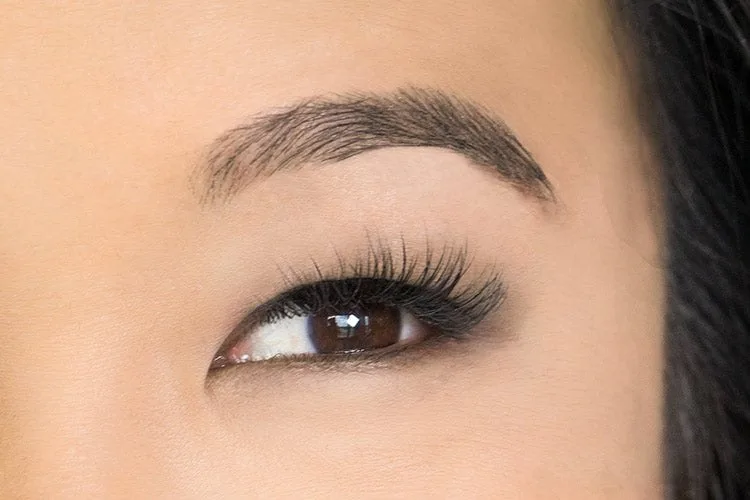
- ShapeAlmond — an even lid, so the lift in this map is invented rather than restored.
- EffectSquirrel with mixed texture: a peak under the arch, wisps down the outer slope.
- Where everyone strugglesNothing on the lid may be longer than the peak zone. Not one stray fan.
Why Why it is laid out this way
Texture on a peaked map has one honest home: the slope after the high point, where a little irregularity makes the descent look soft instead of engineered. Everywhere else it competes with the shape you are drawing. The rule that keeps this cell out of trouble is short — the peak is the ceiling for every strand on the eye.
The order the zones go on, and where the fans land
- Singles carry the climbBuild the rise and the peak in single strands so the zone lengths stay exact. The mix comes afterwards.
- Fill the inner third with fansSoft fans at short lengths cover the quiet zones without adding reach. This is where density is cheapest.
- Texture the descentPast the peak, alternate fan widths so the fall looks a little uneven. That softness is the fox part of the effect.
- Cap everything at the peakNo fan or spike reaches past the longest zone, anywhere. One overshoot outside the peak turns the map into something else.
- Hold the tail up a littleThe outer corner finishes shorter than the peak and longer than the inner corner, with the lightest texture on the map.
The length curve on almond eyes
The diagram climbs to a single high point and steps back down, and the mix has to respect both halves differently. Because almond's lid is already easing off where this peak sits, the rise is entirely your doing and any stray length near it will be read as part of the shape. On the descent the eye is more forgiving, which is why the texture goes there.
Where does a squirrel map go wrong on almond eyes?
Deep The physics underneath
A mixed set is two populations sharing one curve. Below is what each population is worth on the outer third, where this map is longest.
The same map, built four ways
- Classic 1:1
- The singles decide the height of the peak and the rate of the fall, which is why they should own both. A single strand at peak length is the heaviest single object on this map and belongs on the strongest lash you can find in that zone.
- Handmade volume
- Fans give you coverage at a discount on mass, best spent inboard where the map is short and no one is looking. Built by hand, they also let you vary the width along the descent, which is how the texture is made.
- Promade / pre-made fans
- Quick through the quiet zones and reliably identical, which is useful until you want irregularity. On the slope after the peak, identical is precisely the thing you are trying to avoid.
- Woven / clover
- Good coverage per bond, and a shape that repeats — which the eye picks up fastest on a falling line, because it is already watching for change there. Keep it well inboard of the peak.
Spread angle versus weight
Widening a fan spreads the same mass over a bigger footprint and hangs some of it off the lash's own line. On the descent that is a fair trade: the extra width is what makes the fall look feathered rather than ruled. At the peak it is not, because the lid is turning away there and any width you open is paid for in twist without being seen from the front.
What an almond lash line can carry
- A lash reaches its limit by leaning, not by letting go. On this map the first leaner is usually just past the peak, where long fans meet lashes that have started to thin.
- Adding length adds mass and reach together, so a fan on the descent costs more than the same fan two zones inboard even when it looks smaller.
- In a mixed set the fan goes wherever a free lash appears, and the free ones are usually the newest. Judge the outer zones by those, because they decide when the texture starts to sag.
Where this map fails first
The slope after the peak fails first, and it fails as unevenness rather than loss. Its fans are long, its lashes are thinning, and once a few turn over, the varied widths that made the fall look soft start to look like gaps. The peak itself usually survives longer, so the set ends up as a high point with a ragged run of lashes behind it. Fill the descent before touching anything inboard.
FAQ Common questions
Where do the wisps go on a squirrel map?
On the slope after the peak. Texture there reads as a soft fall, whereas the same texture on the climb muddles the rise and makes the peak look accidental.
Can a spike be longer than the peak zone?
Not on this map. The peak is what the whole effect is built around, so anything reaching past it moves the eye's high point and the shape quietly becomes a cat.
Why does hybrid suit a fox look?
Because the fall after the peak wants to look a little irregular, and mixing fan widths gives that without adding length. A perfectly smooth descent looks drawn rather than grown.
Should the inner corner have any texture?
Very little. It is the shortest, finest part of the map, and its job is to stay unnoticed so the outer third gets all the attention.
Print this page or save it as PDF — the diagrams are drawn to stay readable in black and white on plain paper. Or download the diagrams below as SVG. No account, no fee, nothing to sign. Every file carries this page’s address, so wherever it ends up it can be traced back here.
Teaching from these? The offer, and how to credit it.
Also in: Almond eyes · Squirrel / Fox · Hybrid
Read next: fox eye and squirrel lash mapping, and how they differ · questions clients ask about lash extensions