Almond Eyes · Squirrel / Fox · Volume
The squirrel lash map for almond eyes, built in Volume — zone order, where the length peaks, and the point this one usually goes wrong.
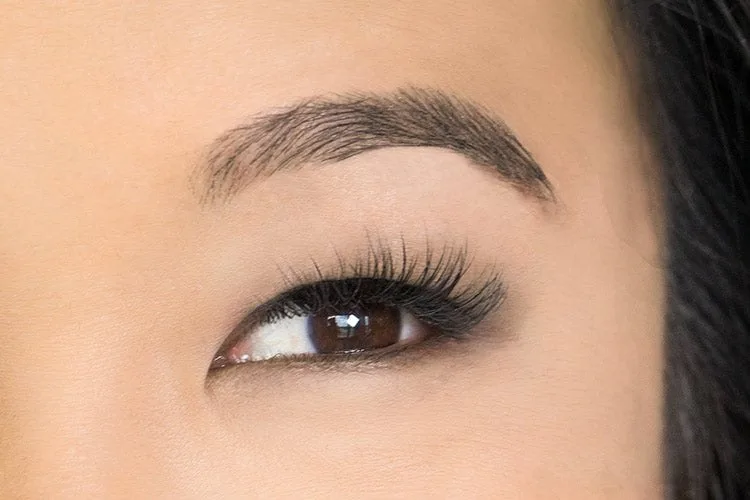
- ShapeAlmond — even lid, so this peak is a design decision, not a repair.
- EffectSquirrel in fans: a layered peak two-thirds out, then a stepped descent.
- Where everyone strugglesShape the base layer too. A flat base under a shaped top reads as a thick, low line.
Why Why it is laid out this way
Layering is the reason to build this shape in fans: the peak needs height on a part of the lid that is already thinning, and a stack of fine strands buys that far more cheaply than one thick strand would. What goes wrong is the division of labour — techs build a level base and then try to carve the effect into the layer above it. The curve has to exist in both layers or it does not exist at all.
The order the zones go on, fan by fan
- Shape the base layer firstThe lower layer follows the full curve, climb and descent included. It is the map, not a foundation.
- Accent the peak on topThe upper layer emphasises the peak zone and the one before it, sitting slightly above the base.
- Narrow the fans as you climbWidest fans in the short inner zones, tightest at the peak, where the length is already doing the work.
- Step both layers down togetherPast the peak, bring base and top down at the same rate so the fall stays clean.
- Single layer at the inner cornerThe first two zones get one light layer only. Stacking there adds weight to the finest lashes for no visible gain.
The length curve on almond eyes
The curve above has one high point and two unequal sides, and volume can print that shape or smother it. Since almond's lid gives no lift where this peak sits, the only reason anyone sees a peak is that its zone stands measurably above its neighbours — and a level base layer raises those neighbours. Build the difference into every layer you lay down.
Where does a squirrel map go wrong on almond eyes?
Deep The physics underneath
Volume trades mass for coverage. This map spends that trade on one zone of height in the least sturdy third of the lid.
The same map, built four ways
- Classic 1:1
- Single strands give the crispest peak and the most honest descent, and they make the whole map cost more where it can least afford it. Worth it on a strong lash line and on a client who wants a sharp edge.
- Handmade volume
- The case for this cell: several fine strands reach peak height for a fraction of a single's mass, and you control the width zone by zone as you climb. That control is what keeps the top of the map from becoming its heaviest part.
- Promade / pre-made fans
- Efficient across a two-layer build and easy to keep consistent between eyes. The fixed spread is the compromise, because this map wants width to shrink exactly as length grows.
- Woven / clover
- High coverage per bond, well suited to the base layer in the short inner zones. Bring it near the peak and its repeating outline sits where every client's eye lands first.
Spread angle versus weight
How far a fan opens changes the footprint of its load, not the size of it. This map's longest fans sit where the lid has begun to curve away, so their width faces the side rather than the front — you pay for it in twist on the bond and collect almost nothing in appearance. Keep the width in the inner zones, which face the viewer squarely, and let the peak be narrow and tall.
What an almond lash line can carry
- The limit is reached when a lash stops standing where you put it. On a layered map that shows as the top layer sinking into the base, so the set loses its dimension without losing a single extension.
- Length is paid for twice over, in material and in reach, and both instalments fall due on the outer third where the lashes are finest. That is why the peak's width, not its length, is usually the thing to cut.
- A fan does not raise the ceiling of the lash it sits on — it lowers the demand. One thinning outer lash is still one anchor, whatever is stacked above it.
Where this map fails first
The peak fails downward rather than outward. Its upper-layer fans are the longest on the map and they sit on lashes that shed sooner than mid-lid ones, so within a few weeks the crown settles level with the base and the eye reads as a full, flat line. Length has not changed and nothing looks bare, which is why this is usually reported as the set having gone dull. Rebuild the top layer over the peak at every fill.
FAQ Common questions
Why does my volume squirrel set look flat?
Almost certainly a level base layer. If the lower layer does not already contain the climb and the descent, the top layer alone cannot make a peak visible.
Which zones take the widest fans?
In the short inner zones. The peak is already the longest point on the map, and adding width there loads the thinnest lashes at the greatest reach.
How many layers should a fox map carry?
Two through the middle and outer zones, one at the inner corner. A third layer buys darkness rather than shape and lands on lashes that are working hard enough.
Is volume or classic better for a fox look?
Volume if you want a soft, full descent or her outer lashes are fine; classic if she wants a sharp peak and her lash line can carry it. The map is the same either way.
Print this page or save it as PDF — the diagrams are drawn to stay readable in black and white on plain paper. Or download the diagrams below as SVG. No account, no fee, nothing to sign. Every file carries this page’s address, so wherever it ends up it can be traced back here.
Teaching from these? The offer, and how to credit it.
Also in: Almond eyes · Squirrel / Fox · Volume
Read next: fox eye and squirrel lash mapping, and how they differ · questions clients ask about lash extensions