Close-Set Eyes · Cat-Eye · Classic 1:1
The cat-eye lash map for close-set eyes, built in Classic 1:1 — zone order, where the length peaks, and the point this one usually goes wrong.
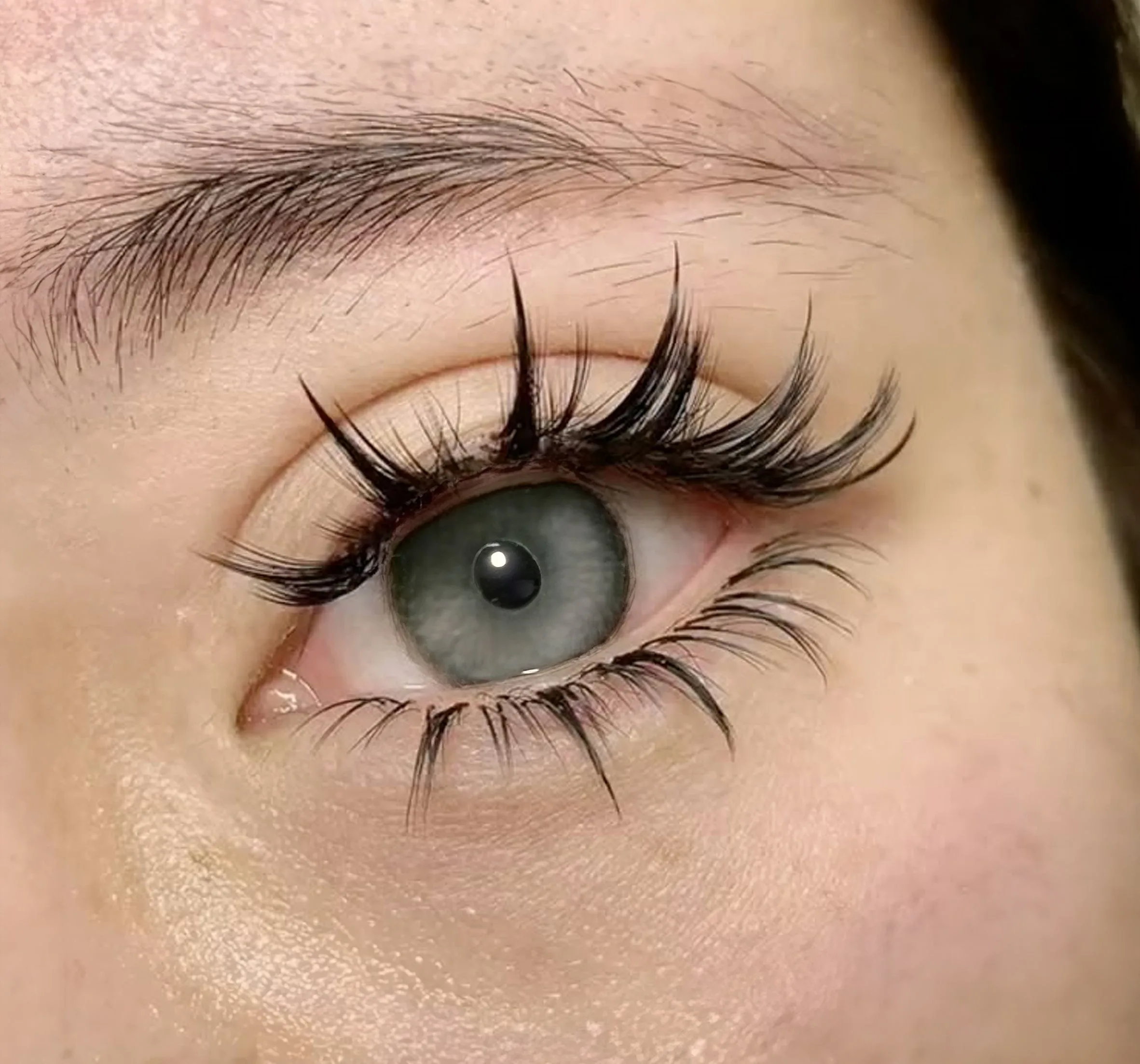
- ShapeClose-set — less than one eye's width of skin between the inner corners.
- EffectCat-eye in single strands: the line climbs all the way to the tail.
- Where everyone strugglesDon't open the flare early. Before the outer iris it gathers the eyes.
Why Why it is laid out this way
The two eyes sit nearer the nose than a full eye's width apart, and every fix for that is the same fix: move the interest outward. Cat-eye does it by design, which is why it is the first map to reach for on this spacing. In single strands the whole correction rides on where you let the length start climbing.
The order the zones go in
- Start short, stay shortFirst two zones are the shortest and finest on the lid. Nothing near the nose should catch light.
- Creep through mid-lidAcross the middle, climb by the smallest step you can place. A rise you can see here has come too soon.
- Open the flare past the irisLength starts climbing properly only once you are outboard of the outer edge of the iris.
- Build the tail to fullUnlike most maps, the last zone is the longest on the set. Nothing is held back at the corner.
- Hold one curl familyKeep a single curl across the lid so the tail reads as length, not as a second effect bolted on.
The length curve on close-set eyes
A face reads the longest, brightest point of a lash line as where that eye is aimed. Sit it at the tail and the pair appears to move apart; sit it near the nose and they gather. This curve is deliberately dull for its first half so everything a viewer notices lands in the outer third.
Where does a cat-eye map go wrong on close-set eyes?
Deep The physics underneath
The whole correction lives at the far end of the lid, which is also the end with the least to give. What follows is about what those last zones can actually hold up.
The same map, built four ways
- Classic 1:1
- Every bit of the flare has to come out of length on one strand, because length is the only variable single lashes hand you. On a map whose last zone is also its longest, that puts the most mass and the longest lever on the same few corner lashes.
- Handmade volume
- Spreading that tail length over several fine strands would cut the load out there sharply. It is the argument for the volume version of this cell, not something you can smuggle into a classic set.
- Promade / pre-made fans
- Same discount with less say in it: the bond node sits at the root where mass is cheapest, but you cannot narrow the spread on the corner lashes that most want it narrow.
- Woven / clover
- A repeating fixed spread reads as pattern, and pattern running out to the tail walks the eye along the lid rather than past it. Wrong tool for a map whose only job is the last third.
Spread angle versus weight
Single strands give you no spread to tune — the mass sits on the lash's own line and stays there. That is the one mechanical advantage classic holds at this tail: nothing carries a twist, so the outer corner keeps whatever angle you set it at.
What a close-set lash line can carry
- Deflection at the outer corner is the ceiling here. The moment the last zone's mass beats what those lashes hold upright, the flare settles and the eyes read close again — long before a single extension falls off.
- Length bills twice at the tail, adding mass and lever in one move, so the step from the second-to-last zone up to the last is the most expensive step anywhere on this map.
- Corner lashes are the finest on the lid, and the finest strand in a zone sets the limit for that zone. Look at the outer corner before you decide how far the flare is allowed to go.
Where this map fails first
The tail goes first and it takes the effect with it. It carries the longest strands on the thinnest lashes, and it is the strip of lid that meets the pillow, the towel and the side of a hand. When it thins, what is left is a line that peaks nowhere — worse than no set on this spacing, because the outward pull was the entire point. Map it so it thins evenly instead of in a block.
FAQ Common questions
Why is a cat-eye the standard pick for close-set eyes?
It moves the longest and most visible lashes as far from the nose as the lid allows. Close-set spacing is corrected by pulling attention outward, and this map does nothing else.
Where exactly should the flare start?
No earlier than the outer edge of the iris. Start it sooner and the widest part of the line sits over the middle of the eye, which gathers the pair instead of separating them.
Does this work if she is also downturned at the corners?
Not as written. Full tail length lands on corners that already point down; that client needs the peak held short of the corner with lift coming from curl, which is a different map.
How short is the inner corner meant to be?
The shortest and finest thing on the lid, and shorter than you would leave on balanced spacing. If it reads at all in a photograph, it is too long.
Print this page or save it as PDF — the diagrams are drawn to stay readable in black and white on plain paper. Or download the diagrams below as SVG. No account, no fee, nothing to sign. Every file carries this page’s address, so wherever it ends up it can be traced back here.
Teaching from these? The offer, and how to credit it.
Also in: Close-Set eyes · Cat-Eye · Classic 1:1
Read next: what a cat eye lash map actually is · questions clients ask about lash extensions