Close-Set Eyes · Cat-Eye · Hybrid
The cat-eye lash map for close-set eyes, built in Hybrid — zone order, where the length peaks, and the point this one usually goes wrong.
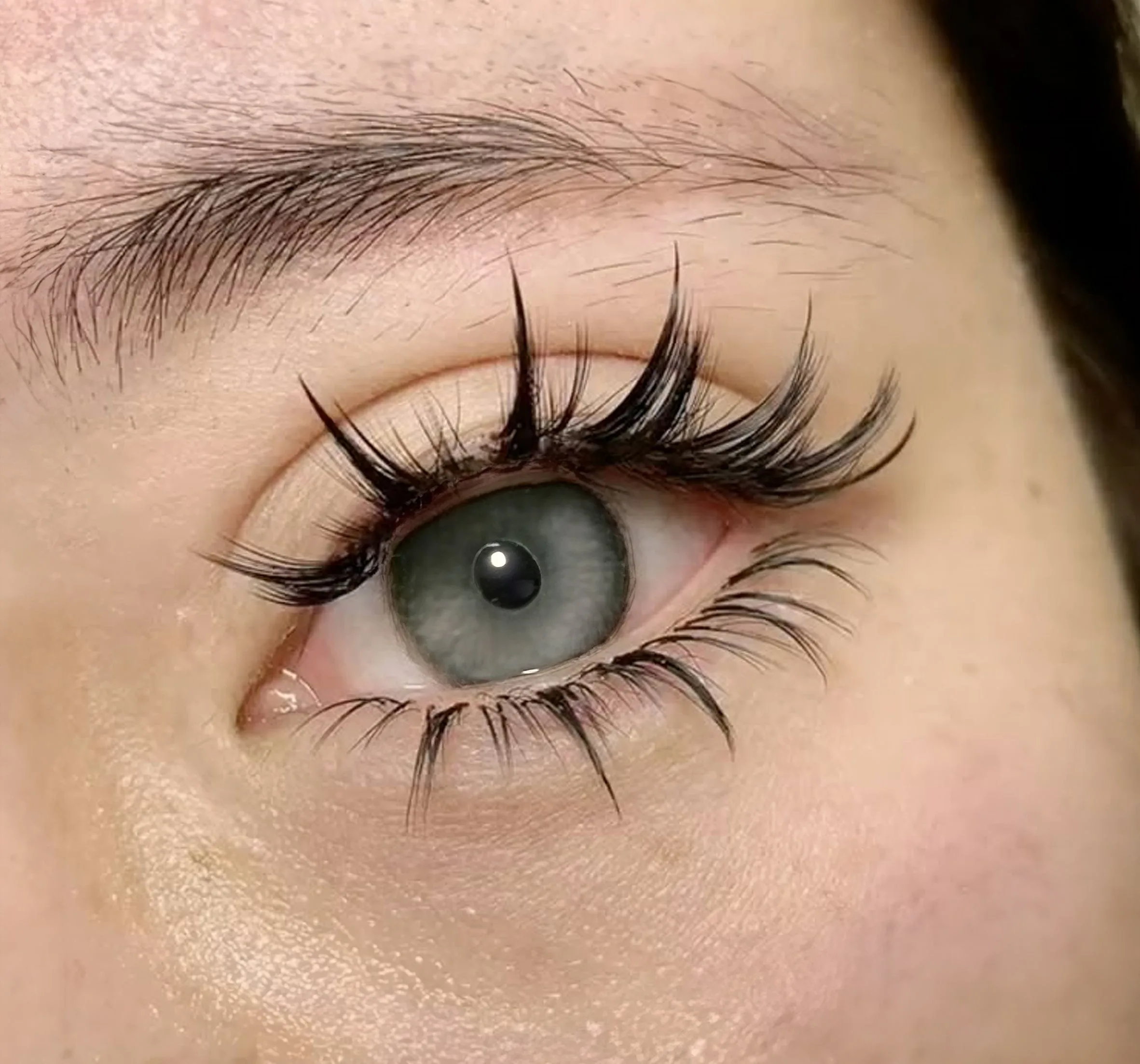
- ShapeClose-set — the bridge between the inner corners is short of an eye width.
- EffectCat-eye with texture: mixed singles and fans, spikes only in the outer third.
- Where everyone strugglesDon't scatter spikes across the whole lid. Bright points near the nose gather the eyes.
Why Why it is laid out this way
A hybrid cat is what clients mean by lashes with edges — singles carrying the shape, soft fans filling behind them, a few closed spikes sitting on top. On eyes set close together the texture is not free, because a spike is read as a highlight and a highlight beside the nose works against the map. Keep every mixed element outboard and leave the inner half plain.
The order the zones go on, and where the fans land
- Lay a plain inner baseFine singles only across the first two zones. Nothing that catches light goes near the nose.
- Let singles set the climbSingle strands carry the length curve from mid-lid out. They are the spine of the shape.
- Fill behind with soft fansFrom the outer iris on, sit fans between the singles at just under the singles' length.
- Scatter spikes outboardA handful of closed fans, longer than their neighbours, all past the outer iris. Scatter, never a row.
- Finish the tail longestThe final zone still tops the map, and the spikes live inside that height rather than above it.
The length curve on close-set eyes
The curve climbs late and finishes at the corner, so the eye is walked out toward the temple instead of back over the bridge. Texture obeys the same rule as length here: a highlight placed inboard pulls the pair together as hard as an over-long inner corner would. Mixed work belongs only where the curve is already tall.
Where does a cat-eye map go wrong on close-set eyes?
Deep The physics underneath
Three different objects hang off the same lid here, each with its own mass and its own lever. The corner carries all three at their longest.
The same map, built four ways
- Classic 1:1
- The singles are the load-bearing part of this cell: they set the climb and the corner height, and everything else is fitted around them. Budget them first, because no fan added afterwards rescues a length curve that was placed wrong.
- Handmade volume
- Fans between the singles buy density for very little mass, which is what the outer third needs once its singles are already at their length limit. Spend that saving closing gaps, not on reaching further.
- Promade / pre-made fans
- Quick work in the plain inner half where nothing is being shaped. At the corner their stiffer base perches on the lash rather than wrapping it, and a perched base is the first thing to turn.
- Woven / clover
- Strong coverage per bond, and no use as texture here, because texture on this map has to look unplanned. A repeating spread across the outer third gives you stripes where you wanted scatter.
Spread angle versus weight
A spike is a fan closed almost flat, so its mass rides on the axis and it behaves like one thick strand — treat it as the heaviest thing you place all appointment. The open fans behind it want just enough width to meet their neighbour; anything past that is mass hanging off the axis at the end of the lid, and it turns.
What a close-set lash line can carry
- The corner is asked to hold a long single, a fan and sometimes a spike within a few lashes of each other. Its ceiling is set by whichever of the three landed on the weakest natural lash, not by the average of the zone.
- A spike costs what a long single costs — full mass, full lever, at the far end. Two or three per eye out there is a scatter; six is a second set with a different name.
- Fans are the cheap part of a hybrid only while they stay under the singles around them. The moment a fan out-lengths its neighbours it pays the same lever penalty with a wider footprint.
Where this map fails first
Spikes go before anything else, being the longest and heaviest objects on the map and sitting where the lid curves away from you. They rarely fall — they rotate, and a turned spike reads as a stray hair rather than as texture. Behind them the corner thins from ordinary wear at the same time. Choosing the strongest lashes you can find in the outer third for the spikes buys weeks of the effect.
FAQ Common questions
Can I put a couple of spikes at the inner corner for balance?
No. A spike is a bright point, and a bright point beside the nose is the quickest way to make close-set eyes look closer. The inner half stays plain.
How many spikes belong on this map?
Few enough to count on one hand per eye. A scatter across the outer third reads as texture; a row of them reads as a second lash line and flattens the climb underneath.
Why hybrid instead of full volume for a close-set cat?
The shape is doing the correcting, and single strands hold a shape more crisply than fans. Hybrid keeps that crisp climb and uses fans only to fill in behind it.
Should the fans match the singles for length?
No, and they should not try. Fans sit just under the singles so the line the singles draw stays the line the eye follows out to the corner.
Print this page or save it as PDF — the diagrams are drawn to stay readable in black and white on plain paper. Or download the diagrams below as SVG. No account, no fee, nothing to sign. Every file carries this page’s address, so wherever it ends up it can be traced back here.
Teaching from these? The offer, and how to credit it.
Also in: Close-Set eyes · Cat-Eye · Hybrid
Read next: what a cat eye lash map actually is · questions clients ask about lash extensions