Close-Set Eyes · Cat-Eye · Volume
The cat-eye lash map for close-set eyes, built in Volume — zone order, where the length peaks, and the point this one usually goes wrong.
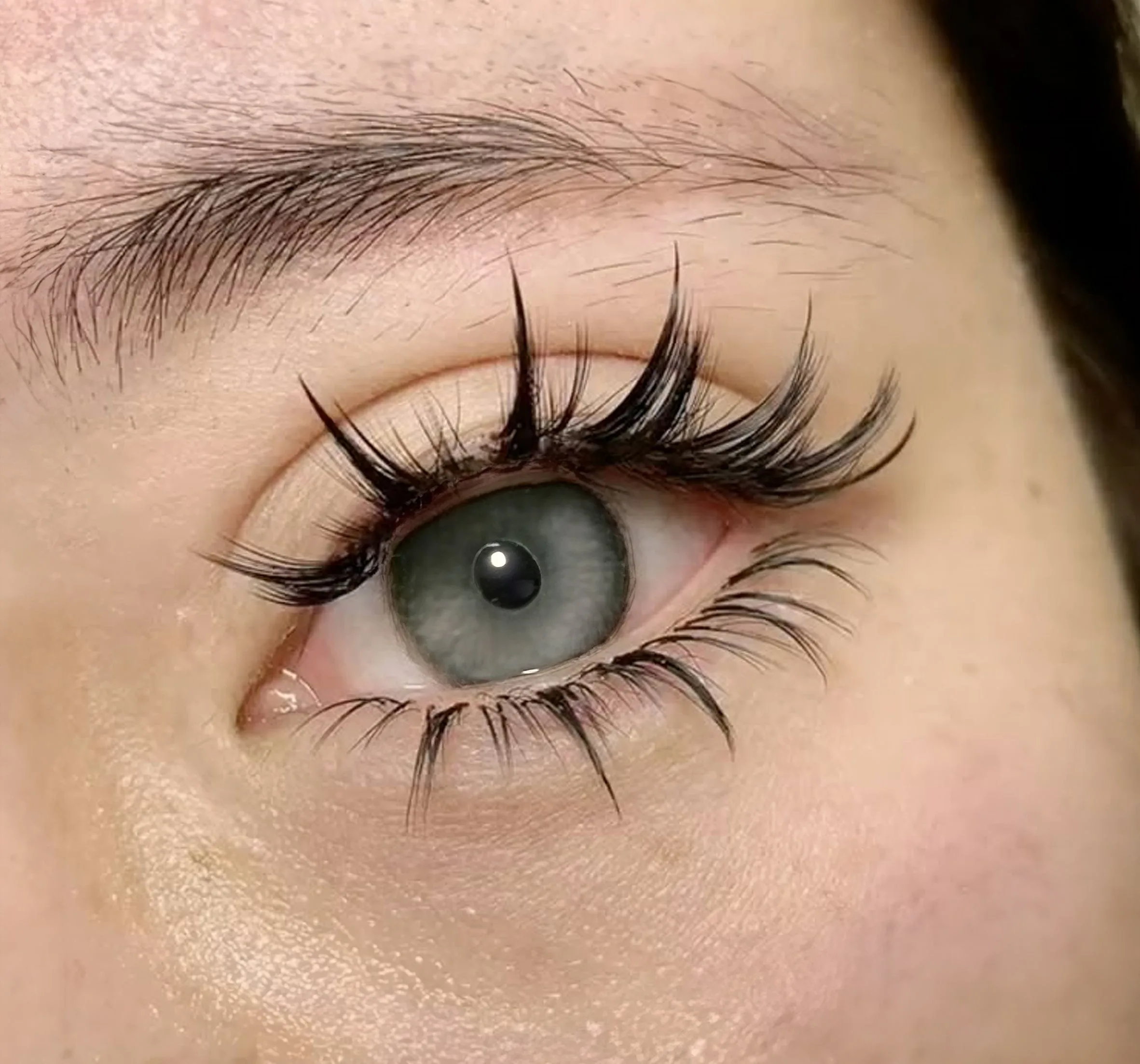
- ShapeClose-set — inner corners crowd the nose, so weight has to travel outward.
- EffectCat-eye in fans: length and darkness both build toward the outer corner.
- Where everyone strugglesDon't run one fan width across the lid. Even darkness pulls the eyes together.
Why Why it is laid out this way
Volume adds a second dial to this map. Beyond length you are now choosing how dark each zone of the line is, and on this spacing darkness behaves exactly like length — cheap out at the corner, expensive anywhere near the bridge. So fan width grows along the same curve the lengths grow along.
The order the zones go on, fan by fan
- Keep inner fans tinyNarrowest fans, fewest strands, shortest length across the first two zones. Density here reads as a shadow beside the nose.
- Widen the fans going outLet width grow with the length curve so the line gets darker step by step rather than all at once.
- Layer past the iris onlyBase plus a directional top layer belongs in the outer third. The inner half stays a single layer.
- Take the tail to fullThe last zone holds both the longest lengths and the widest fans on the set.
- Weigh the corner before you closeSit her up and look with the eyes open. If the tail has already settled, you are over budget and it will not recover.
The length curve on close-set eyes
The curve stays low and thin through the first half, then climbs and thickens together to the corner. Two signals point the same way, so the pull outward is stronger than length alone would give — which is the reason to build this map in fans at all. Break the grading and you have a uniformly heavy line, which on close-set eyes is a correction running backwards.
Where does a cat-eye map go wrong on close-set eyes?
Deep The physics underneath
Volume's whole licence is coverage bought per unit of mass. This map spends the entire discount in one place, and it is the place with the least holding it up.
The same map, built four ways
- Classic 1:1
- Reaching this corner height in single strands means buying it with length, paying in mass and lever together. Possible on a strong outer third; nothing left over for the fill four weeks later.
- Handmade volume
- The reason this cell exists. Several fine strands give the tail its width and its darkness for a fraction of what one thick strand would weigh, and the width is yours to set zone by zone so the inner corner stays quiet.
- Promade / pre-made fans
- Fast and even through the middle of the lid, which is where evenness is welcome. Out at the corner the firmer base sits on the lash instead of wrapping it, and this is the map that can least afford a lifter.
- Woven / clover
- Width per bond delivered as a repeating unit. On a line whose job is to get denser step by step, a fixed unit flattens the very gradient you were building — keep it clear of the zones carrying the effect.
Spread angle versus weight
Opening a fan adds no mass, it moves mass sideways off the lash's own line, and everything off that line asks the lash to resist a twist for weeks. This map stacks its widest fans on the same zones as its longest lengths, so the outer third pays that bill twice over. Give the corner the least width that still fills the gap in front of it.
What a close-set lash line can carry
- The ceiling out here is a rotation, not a shed. Once the corner fans out-weigh what the natural lash holds square, they lie over and the climb disappears while every extension is still firmly attached.
- Splitting one strand into several drops mass faster than it drops coverage, and that saving is what pays for a full-length tail. Spend it on keeping the corner upright, not on going longer than the map asks.
- However many strands are in it, a fan is one object on one lash. The lash under the widest fan on the set should be one of the strongest in the outer third, which means going and looking rather than assuming.
Where this map fails first
Two clocks run at once on this map. The corner fails mechanically — widest fans, longest lengths, finest lashes, and the strip of lid that meets the pillow — so it lies over and the flare flattens. The inner corner fails by calendar instead: fill after fill it collects a little more than it should, and an outward-weighted map drifts back to even without anyone deciding it. Cut the inner corner back at every fill rather than only topping it up.
FAQ Common questions
Does volume make close-set eyes look closer together?
It does when the density is even. Volume decides how dark each zone reads, and a uniformly dark line puts visual weight beside the nose — grade the width outward and it works the other way.
How narrow should the inner-corner fans be?
Narrow enough that you would describe them as a few strands rather than as a fan. Those first zones exist to stay quiet, not to be built up.
Where does the second layer start?
Past the outer iris and no earlier. Layering the inner half raises the whole line and undoes the gradient this map is built on.
Is a full-length tail safe in volume?
Only against the lash line in front of you. Fans reach that length for less weight than a single strand would, but the corner lashes are the finest on the lid and they set the real limit.
Print this page or save it as PDF — the diagrams are drawn to stay readable in black and white on plain paper. Or download the diagrams below as SVG. No account, no fee, nothing to sign. Every file carries this page’s address, so wherever it ends up it can be traced back here.
Teaching from these? The offer, and how to credit it.
Also in: Close-Set eyes · Cat-Eye · Volume
Read next: what a cat eye lash map actually is · questions clients ask about lash extensions