Close-Set Eyes · Doll / Open-Eye · Hybrid
The doll lash map for close-set eyes, built in Hybrid — zone order, where the length peaks, and the point this one usually goes wrong.
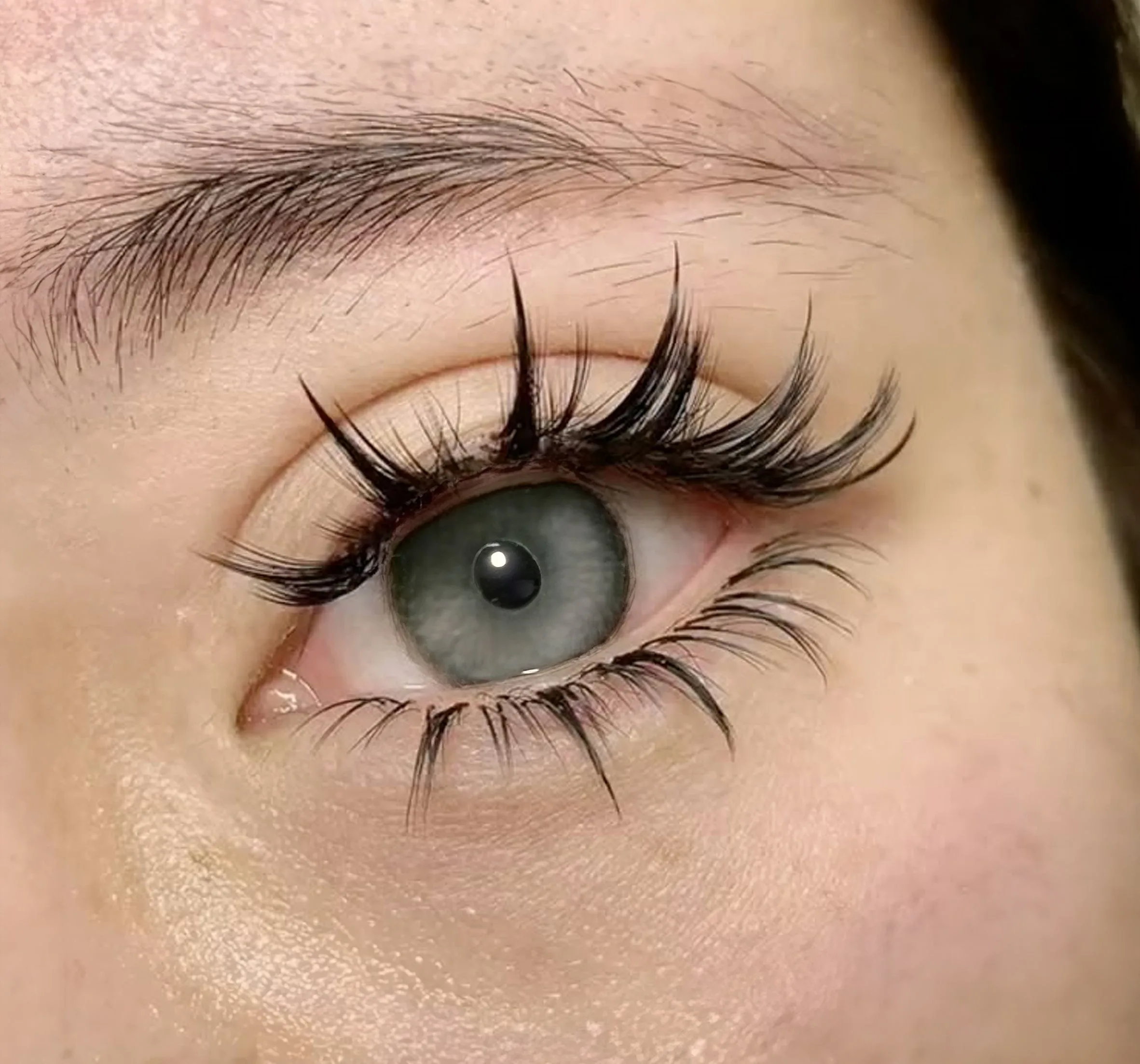
- ShapeClose-set — the eyes sit closer than one eye width, so interest must move outward.
- EffectDoll with texture: a round top shifted outboard, spikes only past the high point.
- Where everyone strugglesDon't texture the nose side of the peak. That is where this map fails.
Why Why it is laid out this way
Hybrid asks for a broken edge, doll asks for a smooth one, and close-set spacing asks for everything interesting to happen away from the nose. All three pull different ways in this cell. The settlement is a mostly smooth curve with its texture confined to the shoulder just outboard of the peak — and if the client is flexible, cat or squirrel does the spacing job without the argument.
The order the zones go on, and where the fans land
- Plain singles inboardFirst two zones are fine single strands, shortest on the lid, nothing mixed in with them.
- Let singles draw the climbSingles carry the rise from the third zone up to the peak, so the curve stays readable as a curve.
- Fan the peak for bodySoft fans between the singles across the peak row, level with them — fullness without a coarse edge.
- Texture the shoulder onlyThe few spikes on this set sit just outboard of the peak, inside the falling length. Never on the nose side of it.
- Fall to a short cornerLength drops steeply after the shoulder and the texture stops with it. A textured corner turns this into a cat you did not plan.
The length curve on close-set eyes
The high point has been dragged off centre to the outer iris, which is as far as a round effect travels before it stops looking round. Texture is then placed to back that shift up rather than dilute it, so the busiest part of the eye is also its furthest part from the nose. Inboard of the peak the map goes deliberately smooth and quiet.
Where does a doll map go wrong on close-set eyes?
Deep The physics underneath
Three kinds of object, one round curve, and a peak already moved as far outboard as it will go. The mechanics decide how much texture that curve survives.
The same map, built four ways
- Classic 1:1
- Singles draw the curve, and on a round map the curve is the whole product. They are also the only part of the mix you place with real precision, so they decide where the high point actually lands.
- Handmade volume
- Fans fill the peak row so it looks full without asking any single strand to be thicker. Keep them level with the singles rather than over them, or the top stops being a top.
- Promade / pre-made fans
- Handy through the quiet inner half where you only want a tidy even base. Around the peak their fixed width removes the fine control this map needs at the one row that defines it.
- Woven / clover
- Even coverage in a repeating unit, which across a round top comes out as scalloping. This map can afford to lose most things, but not the smoothness of its curve.
Spread angle versus weight
Width is the thing a round top cannot afford. Open the fans across the peak row and the outline softens into a blur, which is precisely what this effect was bought to avoid, so give them just enough width to meet each other. A spike is the same object with no width at all — every strand on one line, on one lash — which is why only two or three of them belong out on the shoulder.
What a close-set lash line can carry
- The peak row sits on deep, strong lashes and takes the fan weight comfortably. The shoulder just outboard of it does not, because it is already shortening — and that is exactly where the texture has been placed.
- A spike costs its full length in both mass and lever. On a falling tail, a spike that matches the peak height is a long lash riding a short lash's lever, and it will not stay square for long.
- The weakest strands on the shoulder decide how long the texture lasts. Choose the lashes you spike by looking at them, not by taking whichever one comes next.
Where this map fails first
Check the shoulder first. Its spikes are the longest things on a stretch of lid that has already started shortening, so they rotate before anything sheds and go from texture to strays. The peak fails second and more quietly, settling until the round top flattens out. Because this effect is a shape rather than a density, both failures look like the map vanishing rather than the set thinning.
FAQ Common questions
Can a doll map take texture at all?
A little, and only outboard of the peak. Doll lives on a smooth curve, so every spike spends part of the effect — put them where they at least help the spacing.
On close-set eyes, where should the accents sit?
On the outer side of the high point and nowhere else. A bright broken edge beside the nose is the fastest way to shrink the gap you are trying to widen.
Is hybrid the best technique for doll on this shape?
It is the most demanding of the three. Classic keeps the curve cleanest, volume gives the fullest top, and hybrid is for a client who wants round but slightly undone.
Should I talk her out of doll on close-set eyes?
Offer the alternative plainly and let her choose. Cat or squirrel corrects this spacing properly; if she still wants round, this shifted map is as far as round can be taken.
Print this page or save it as PDF — the diagrams are drawn to stay readable in black and white on plain paper. Or download the diagrams below as SVG. No account, no fee, nothing to sign. Every file carries this page’s address, so wherever it ends up it can be traced back here.
Teaching from these? The offer, and how to credit it.
Also in: Close-Set eyes · Doll / Open-Eye · Hybrid
Read next: open eye versus doll — one family, two intents · questions clients ask about lash extensions