Close-Set Eyes · Natural · Hybrid
The natural lash map for close-set eyes, built in Hybrid — zone order, where the length peaks, and the point this one usually goes wrong.
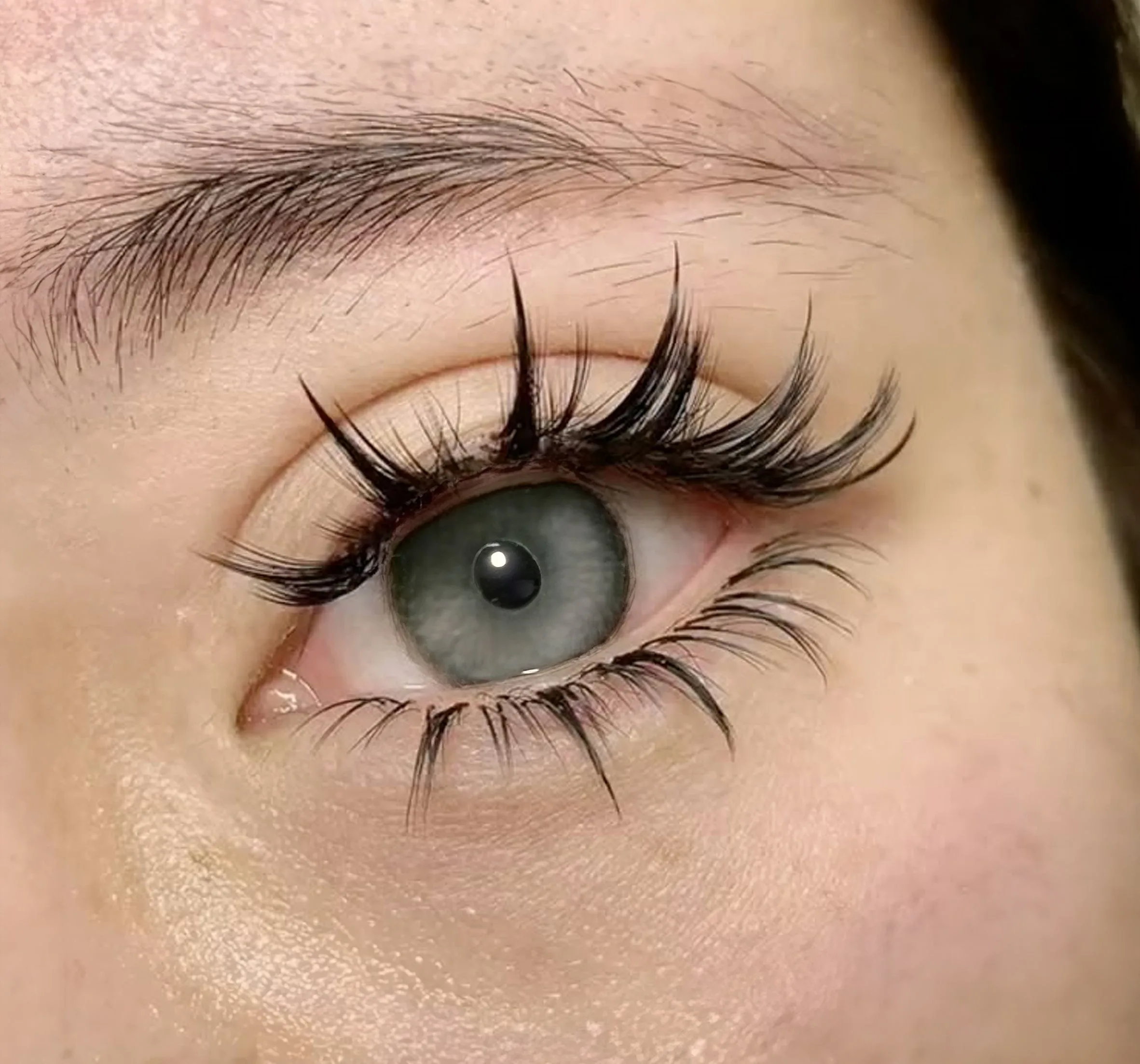
- ShapeClose-set — the eyes sit nearer the nose than one eye's width apart.
- EffectNatural with body: singles draw the shifted curve, soft fans fill behind them.
- Where everyone strugglesDon't fill evenly. Fullness near the nose works against the whole map.
Why Why it is laid out this way
Hybrid here is not the spiky sort. Single strands carry the length curve and soft fans are filled in behind them, so the line gains body without announcing itself. On this spacing that body obeys the same rule as the length: plenty of it outboard, almost none of it near the nose.
The order the zones go on, and where the fans land
- Singles only at the nose endInner two zones stay plain single strands, shortest on the lid. No fans go in beside the nose.
- Let singles set the curveSingle strands carry the length steps from mid-lid outward. They define the shape; the fans never do.
- Fill behind from mid-lidStart adding soft fans at the third zone, always sitting just under the singles' length.
- Densest through the peakThe outer third takes the most fans on the set, putting the fullest part of the line furthest from the bridge.
- Let fans hold the tailKeep filling to the corner. Fans are how the tail stays near full without the weight of longer singles.
The length curve on close-set eyes
The length curve is the shift: peak outboard, corners short, tail carried. Hybrid lays a second gradient underneath it, because how many fans sit in a zone decides how full it looks, and fullness pulls the eye the same way length does. Both gradients run the same direction here, which is why this reads stronger than a plain natural set built to the same lengths.
Where does a natural map go wrong on close-set eyes?
Deep The physics underneath
Two kinds of object on one line, both pretending to be a single thing. What follows is how they share the load on a map with a heavy outer half.
The same map, built four ways
- Classic 1:1
- The singles are the skeleton here: they hold the length curve and the corner height, and they go where the map has to be exact. Everything else is fitted around decisions they have already made.
- Handmade volume
- Fans are why this tail can be carried near full without the outer lashes protesting. Build them fine and narrow and give them density work only.
- Promade / pre-made fans
- Convenient across the middle zones, where the filling is repetitive anyway. Nearer the corner their firmer base sits proud on a shallow lash and lifts sooner than a handmade fan would.
- Woven / clover
- Coverage per bond in a fixed shape, which suits a map wanting to look unplanned very badly. If it appears at all it belongs in the base of the mid-lid zones, never at the tail.
Spread angle versus weight
Every fan on this map should be narrow enough that you would describe it as a couple of strands rather than a fan, because width is what turns a hybrid natural into something the client notices. At the tail there is a mechanical reason too: width parks mass off the lash's own line, and shallow outer lashes already holding near-full length have nothing spare for a twist.
What a close-set lash line can carry
- The outer half holds the longest singles and the most fans at the same time, so its ceiling is reached by the two of them together rather than by either on its own.
- Fans buy coverage far more cheaply than length does, but only while they stay shorter than the singles beside them. Let one match the singles and it pays the full length penalty with a wider footprint.
- One lash carries one object, whatever kind it is. The thinnest lashes at the tail decide when this map begins to sag, and they take no interest in the load being split between two techniques.
Where this map fails first
Fans lift before singles do, and most of the fans on this map live in the outer half, so the first sign is the tail losing body rather than losing length. It shows as a line thinning toward the corner while the peak still looks right, which a client reads as her eyes narrowing again. Check the shallow zone just short of the corner at every fill, because lifted bases hide there. The singles will still be in place long after the fans have gone.
FAQ Common questions
What does hybrid actually add on a natural close-set map?
Body rather than texture. The fans decide how full each zone looks, and stacking that fullness in the outer third pushes the eye outward on top of what the length curve is already doing.
Should this set have spikes?
No. Spikes belong to a wispy map; here they would be the one detail she could point at, and on this spacing a badly placed one makes the eyes look closer.
Where do the fans stop at the inner corner?
Before it. The first two zones stay single strands, because a fan beside the nose adds fullness at the only stretch of lid that has to stay quiet.
How long should the fans be next to the singles?
Just under them, in every zone. The singles draw the line the eye follows, and a fan reaching past them blurs the shape the whole map is built on.
Print this page or save it as PDF — the diagrams are drawn to stay readable in black and white on plain paper. Or download the diagrams below as SVG. No account, no fee, nothing to sign. Every file carries this page’s address, so wherever it ends up it can be traced back here.
Teaching from these? The offer, and how to credit it.
Also in: Close-Set eyes · Natural · Hybrid
Read next: questions clients ask about lash extensions