Close-Set Eyes · Natural · Volume
The natural lash map for close-set eyes, built in Volume — zone order, where the length peaks, and the point this one usually goes wrong.
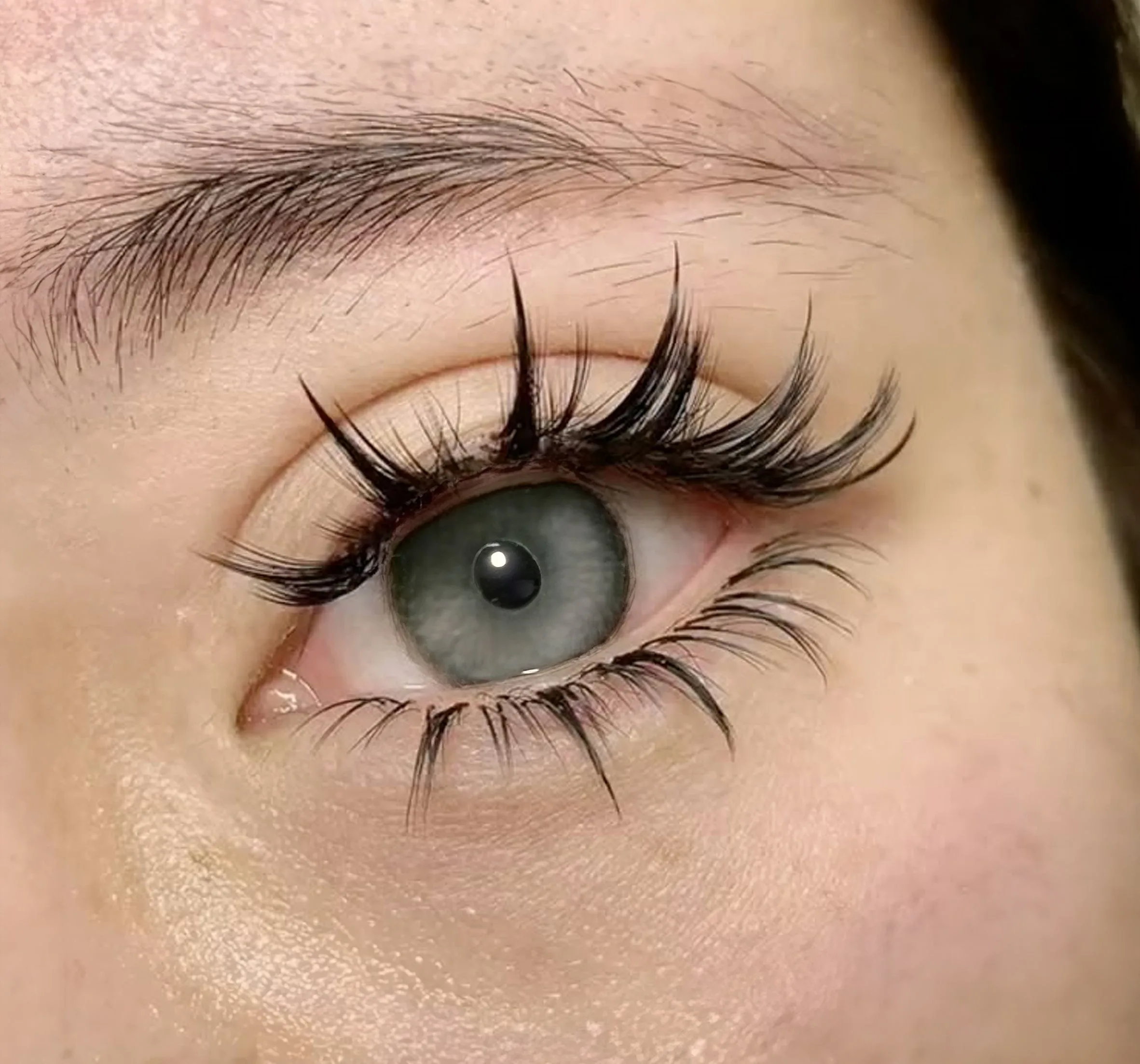
- ShapeClose-set — a narrow gap at the bridge, so the solid work belongs outboard.
- EffectNatural in fans: graded density, open inner corner, full tail.
- Where everyone strugglesDon't run a solid line into the inner corner. It points straight at the nose.
Why Why it is laid out this way
A natural volume set is judged at the root, not the tip — what the client sees is how solid her lash line looks with her eyes open. That solidity behaves like a line drawn along the lid, and a line running right into the inner corner aims at the nose. So this map leaves the first zones deliberately open and saves its density for the outer half.
The order the zones go on, fan by fan
- Leave the corner openSkip lashes at the nose end rather than fanning every one. An open inner corner is part of this design.
- Start density at mid-lidFrom the third zone on, fill every lash and let the fans widen a little at a time.
- Peak in the outer thirdThe longest and widest fans sit past the middle, between the outer iris and the corner.
- Layer the outer half onlyA shorter under-layer from mid-lid outward gives depth exactly where the map wants weight.
- Keep the tail fullDrop only slightly after the peak and hold the fill dense. A thin corner walks the eye back inward.
- Match direction, not just lengthFans across the outer half point the same way. Stray directions read as mess long before they read as texture.
The length curve on close-set eyes
Volume hands you a lash line whose darkness you can grade, and grading is the whole opportunity on this shape. Lengths rise to a peak in the outer third and density rises with them, so the solid part of the line sits away from the bridge while the corner nearest the nose stays open. Together they make the eyes look further apart without the set looking built.
Where does a natural map go wrong on close-set eyes?
Deep The physics underneath
Fans everywhere, gaps on purpose, and a corner asked to stay full. Below is the arithmetic under a set built to look like nothing happened.
The same map, built four ways
- Classic 1:1
- Singles give the same length curve with none of the density control, and density control is the point of this cell. They still earn a place as the finest work at the inner corner, where any fan is too much fan.
- Handmade volume
- The reason to build a natural set this way: fine strands split across a lash give fullness for a fraction of the weight, and the width is yours to choose zone by zone. That per-zone control is what draws the gradient.
- Promade / pre-made fans
- Speed and repeatability through the middle of the lid. Their fixed spread makes the inner corner harder, because the narrowest one you own may still be more fan than those zones can take.
- Woven / clover
- Broad coverage from a single bond, which sounds ideal for a full outer half until you notice the repeat. On a natural set the repeat is the tell, and it shows worst in the zone she photographs.
Spread angle versus weight
Width is how dark a zone reads, so spread is the gradient on this map. Fans open gradually from mid-lid to the peak and stay narrow on either side of it, which puts the widest work on the deepest lashes and keeps the corner's gap intact. Two zones of extra width near the nose would undo the shift faster than any length error could.
What a close-set lash line can carry
- The peak and the tail hold the widest fans and the longest lengths between them, so the ceiling on this map lives in the outer half. Pass it and the fans lie over: the line loses depth rather than length, and every extension is still attached.
- Splitting a strand drops mass faster than it drops coverage, and that discount is what lets the tail stay full. Spend it on length instead and it evaporates, because length adds mass and reaches further along the lever in the same move.
- The weakest lashes in a zone decide what the zone holds. On a layered outer half, look at what is carrying the under-layer too — those lashes were picked when the zone was still empty.
Where this map fails first
Depth goes before length here. The widest fans sit across the peak and tail, and once they lie over the line reads flatter while nothing has actually shed. The gap at the inner corner fails the other way: leaving a corner open feels wrong, so it quietly gets closed — by her own regrowth, or by whoever does the next fill and assumes it was missed. Put the open corner in her notes so nobody helpfully fixes it.
FAQ Common questions
Should I really leave the inner corner unfilled?
Open rather than empty: the shortest and finest work on the set, with some lashes skipped instead of every one fanned. A solid line running into the corner aims at the nose and shortens the gap.
Can volume look natural on close-set eyes?
Yes, when the density is graded. What makes volume look done is an even wall of black along the lid; grading it outward makes it read as a good lash line instead.
Where does the second layer belong?
Outer half only, and shorter than the layer above it. Depth added at the nose end raises the part of the map that is meant to stay quiet.
How full should the tail be?
Nearly as full as the peak. Thinning the corner is the standard natural habit, and it is the habit that gives the correction straight back.
Print this page or save it as PDF — the diagrams are drawn to stay readable in black and white on plain paper. Or download the diagrams below as SVG. No account, no fee, nothing to sign. Every file carries this page’s address, so wherever it ends up it can be traced back here.
Teaching from these? The offer, and how to credit it.
Also in: Close-Set eyes · Natural · Volume
Read next: questions clients ask about lash extensions