Close-Set Eyes · Squirrel / Fox · Classic 1:1
The squirrel lash map for close-set eyes, built in Classic 1:1 — zone order, where the length peaks, and the point this one usually goes wrong.
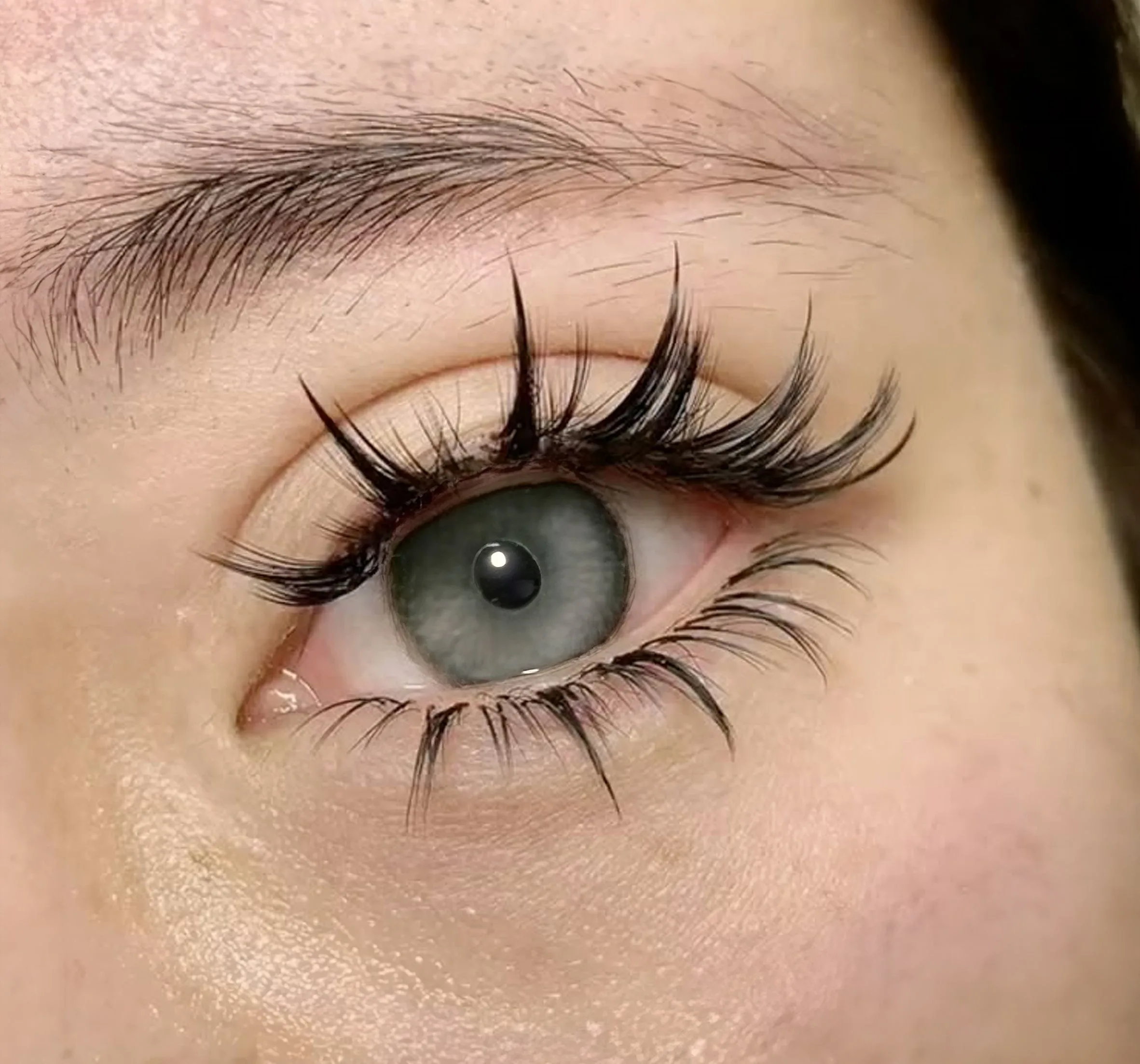
- ShapeClose-set — the inner corners sit close, so the tall point has to move out.
- EffectSquirrel in single strands: an arch over the outer iris, easing down after it.
- Where everyone strugglesDon't drop steeply after the arch. A fast fall pulls the weight back to centre.
Why Why it is laid out this way
Squirrel puts an arch on the lid rather than a flare at the corner, and on this spacing the arch is set out over the outer iris. That buys two things at once: the lift of a raised high point, and a centre of interest well clear of the nose. It is the gentler of the two corrective maps for this shape — a cat pulls harder, this one looks less like a decision.
The order the zones go in
- Short but not flat inboardThe inner corner is still the shortest work on the lid, though this map begins climbing a zone earlier than the others.
- Rise steadily to the archEven steps up through mid-lid, so the arch arrives as a curve rather than as a step.
- Arch over the outer irisThe high point sits over the outer edge of the iris: far enough out to separate, far enough in to still read as lift.
- Come down gentlyEase the length back after the arch. A quick drop re-centres the weight and cancels the separation.
- Finish with a real cornerThe last zone stays clearly longer than the inner corner. A tail cut short closes the eye back up.
The length curve on close-set eyes
The arch does two jobs at once. Raised, it opens the eye upward, which is the ordinary squirrel payoff; placed outboard of centre, it also carries the tallest point of the line away from the bridge. The fall after it is slow on purpose, because a fast drop puts the visual weight back over the middle of the eye and the second job is lost.
Where does a squirrel map go wrong on close-set eyes?
Deep The physics underneath
One strand per lash, and one row of them carrying the whole effect. What follows is what that row can hold and how the line ages around it.
The same map, built four ways
- Classic 1:1
- The arch is drawn with length alone here, and single strands draw it more sharply than fans do. The effect lives inside about a zone and a half of lid, so precision at that row outweighs everything else on the set.
- Handmade volume
- Fans would make the arch tall and full without a thick strand, which is what the volume build of this map is for. In a classic set the same height has to be paid for in mass on one lash.
- Promade / pre-made fans
- Quick and even, and evenness flatters a smooth arch. What goes is the ability to adjust a single lash at the top of the curve — in this cell, the lash the client will look at.
- Woven / clover
- A repeating unit across the top of an arch makes the curve look notched. Almost anywhere else on this line it would pass unnoticed; here it will not.
Spread angle versus weight
Classic gives you no spread to manage, so the arch's shape comes entirely from length steps and from every strand at the top pointing the same way. Two lashes leaning differently at the high point read as a broken arch even when their lengths are exactly right, and that is the classic-specific failure on this map.
What a close-set lash line can carry
- The arch sits over reasonably deep lashes, so it is not the most stressed peak in the library. It is still the tallest point on the set, and the first place a length misjudgement shows up as a strand sitting low.
- The gentle fall after the arch is doing mechanical work as well as visual work: it keeps real length off the shallow outer zones, so the corner is carrying less than it appears to be.
- Each zone is held up by its weakest strands. On the arch row, one fine lash under a long extension drops out of the curve and leaves a dent you can see from across a room.
Where this map fails first
The arch is the tallest thing on the set and it is what she came in for, so its failure is the visible one — a few strands settling and the curve losing its top. The corner fails more slowly and much more quietly, and that is the one that matters for spacing: as the tail thins, the fall after the arch steepens by itself and the map drifts back toward centre. Both are answered the same way, by filling the outer half before the inner half asks for it.
FAQ Common questions
What is the difference between a squirrel and a cat map here?
Where the high point sits. A cat climbs all the way to the corner; a squirrel arches over the outer iris and eases back down, correcting the spacing more softly for a client who does not want an obvious lift.
How steep should the drop after the arch be?
Gentle enough that you cannot see where it starts. A steep fall puts the visual weight back over the middle of the eye and hands back the separation the arch just bought.
Where exactly does the arch go on close-set eyes?
Over the outer edge of the iris rather than over the pupil. That is as far out as an arch travels while still reading as lift instead of turning into a flare.
Is classic strong enough to hold an arch?
It holds the shape well, because single strands draw a crisper curve than fans. The limit is height — the arch can only be as tall as one strand on one lash will stay upright.
Print this page or save it as PDF — the diagrams are drawn to stay readable in black and white on plain paper. Or download the diagrams below as SVG. No account, no fee, nothing to sign. Every file carries this page’s address, so wherever it ends up it can be traced back here.
Teaching from these? The offer, and how to credit it.
Also in: Close-Set eyes · Squirrel / Fox · Classic 1:1
Read next: fox eye and squirrel lash mapping, and how they differ · questions clients ask about lash extensions