Close-Set Eyes · Squirrel / Fox · Hybrid
The squirrel lash map for close-set eyes, built in Hybrid — zone order, where the length peaks, and the point this one usually goes wrong.
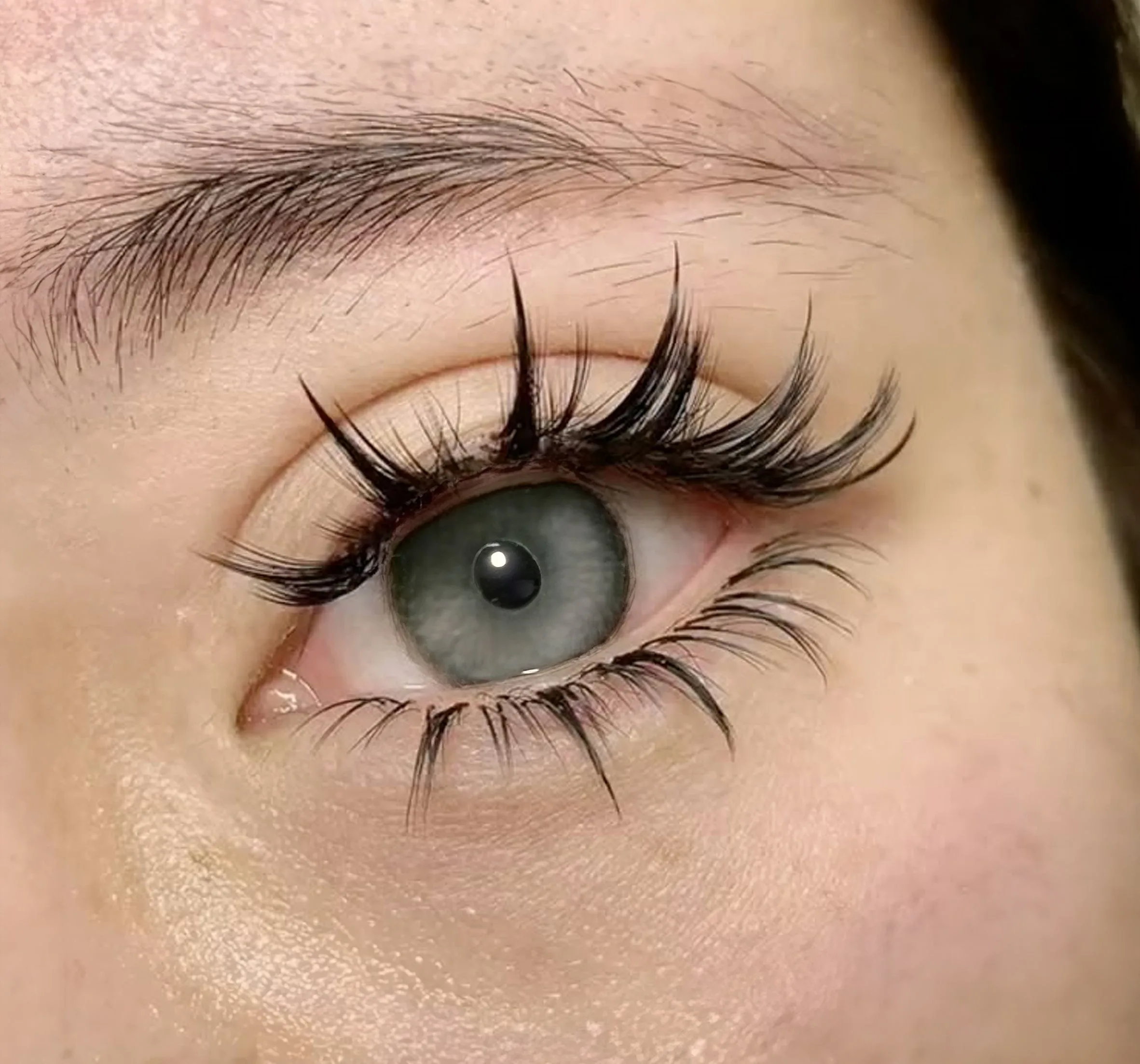
- ShapeClose-set — a short gap at the bridge, so the busy part belongs outboard.
- EffectSquirrel with a broken edge: arch in singles, texture on the falling side only.
- Where everyone strugglesDon't texture the nose side of the arch. Bright points there close the gap.
Why Why it is laid out this way
An arch with a broken edge is a common ask, and on this spacing it comes with a rule attached: the broken part begins at the arch and runs outward, never before it. Singles build the climb and the top of the curve, fans fill in behind, and a handful of spikes sit on the outer slope. The inner half stays plain and short so nothing invites the eye to stop near the nose.
The order the zones go on, and where the fans land
- Plain climb inboardSingles only from the inner corner up to the arch. No texture on the nose side of the high point.
- Singles own the archThe top of the curve is single strands, so the arch keeps a clean outline you can actually see.
- Fill behind from mid-lidSoft fans behind the singles from mid-lid out, sitting just under them in length.
- Spikes on the outer slopeThe few spikes go on the falling side of the arch, tucked inside the length rather than standing over it.
- Keep the fall softLength eases down to a real corner. Texture is not an excuse for a short tail.
The length curve on close-set eyes
The arch over the outer iris carries the shape, and the texture is placed to back it up. A spike reads as a bright point, so the same spikes on the nose side of the arch would put the busiest part of the eye where the spacing is tightest — which is why the whole textured half sits outboard of the high point. The soft fall then keeps the outer third occupied, so the eye finishes there instead of walking back to the middle.
Where does a squirrel map go wrong on close-set eyes?
Deep The physics underneath
An arch, a fill and a few spikes, sharing a lid that gets shallower the further out you go. Below is who is carrying what.
The same map, built four ways
- Classic 1:1
- Singles hold the arch and the climb into it, which is where this map is either right or wrong. Nothing you add afterwards moves a high point that was placed in the wrong zone.
- Handmade volume
- Fans fill behind the arch and along the fall, keeping the outer third occupied without adding length out there. That is where hybrid earns its keep on this spacing.
- Promade / pre-made fans
- Fine through the plain inner half. On the falling slope their firmer base has less lash to grip, and this map's separation depends on that slope staying populated.
- Woven / clover
- Predictable width from one bond, and predictability is the enemy of a broken edge. Once the texture reads as a pattern it stops reading as lashes.
Spread angle versus weight
The spikes here are closed fans, all their mass on the axis, behaving like the heaviest single strands on the set — and they land on the outer slope where the lash line has already begun to shorten. Keep the open fans behind them narrow, because on a falling curve extra width sits off-axis on lashes that are leaning already, and it turns up as visible twist within weeks.
What a close-set lash line can carry
- The arch row is the strongest part of this map and the outer slope the weakest, which is awkward, since the outer slope carries all the texture. Its ceiling is whatever the shortest lashes on that slope hold square.
- A spike costs full length in mass and in lever wherever it lands. On the fall, where the natural lashes are shorter, the same spike works through a longer effective lever than it would at the arch.
- Fans stay the cheap option only while they stay under the singles beside them. The moment one is longer, it is paying a single's penalty with a wider footprint on a thinner lash.
Where this map fails first
The outer slope goes first, holding the heaviest objects on the shallowest lashes. Its spikes rotate rather than shed, and a turned spike beside a soft fall looks like an error rather than texture. The arch settles later and more quietly, and when it does the set reads flat rather than sparse. If she stretches her fills, warn her that the texture is the first thing to go — it is also the part she will miss.
FAQ Common questions
Can spikes sit on the inner half of a squirrel map?
Not on close-set eyes. A spike is a bright point, and the nose side of the arch is the one stretch of lid that has to attract nothing.
How does hybrid change a squirrel arch?
It softens the edge without moving the shape. Singles still draw the arch; the fans and spikes only decide how crisp or how undone that arch looks.
Where do the fans sit relative to the arch?
Behind the singles and just under them, from mid-lid right out to the corner. They keep the outer third full without adding length to the shallow zones.
Does the tail still matter when there is texture out there?
More than ever. Texture on a short tail is busyness with nowhere to go — the fall has to reach a real corner or the separation collapses back to the middle.
Print this page or save it as PDF — the diagrams are drawn to stay readable in black and white on plain paper. Or download the diagrams below as SVG. No account, no fee, nothing to sign. Every file carries this page’s address, so wherever it ends up it can be traced back here.
Teaching from these? The offer, and how to credit it.
Also in: Close-Set eyes · Squirrel / Fox · Hybrid
Read next: fox eye and squirrel lash mapping, and how they differ · questions clients ask about lash extensions