Close-Set Eyes · Squirrel / Fox · Volume
The squirrel lash map for close-set eyes, built in Volume — zone order, where the length peaks, and the point this one usually goes wrong.
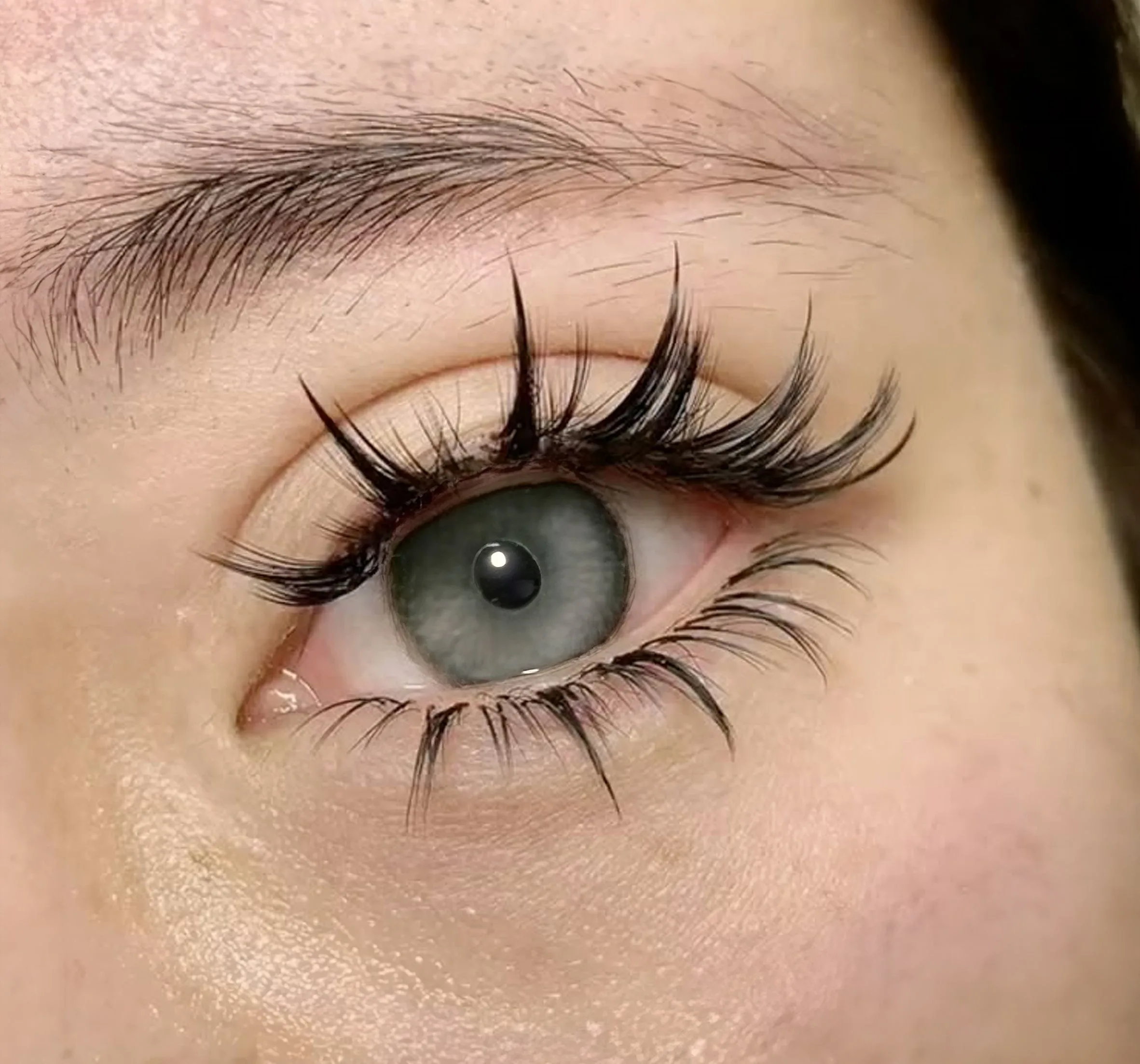
- ShapeClose-set — under an eye's width apart, so visual weight has to live outboard.
- EffectSquirrel in fans: arch at the outer iris, length falling while density holds.
- Where everyone strugglesDon't let the fill thin out with the length. The corner has to stay dense.
Why Why it is laid out this way
Volume gives this map something classic cannot: the fall after the arch can be made of density instead of length. Lengths ease down past the outer iris while the fan count stays up, so the outer third keeps its weight without asking shallow lashes to hold long strands. The arch stays the top of the line, and keeping it readable is the discipline the whole cell rests on.
The order the zones go on, fan by fan
- Narrowest fans at the noseInner zones take the fewest strands and the least width anywhere on the set.
- Build width into the climbLet the fans widen zone by zone as the lengths rise, so the line thickens on its way to the arch.
- Keep the arch row tidyFans at the very top match each other and stay narrow. A blurred top row is an arch nobody can see.
- Layer from mid-lid outThe under-layer runs from mid-lid to the corner, adding depth across the half that has to hold weight.
- Fall in length, not in fillPast the arch the lengths come down while the fill stays dense right to the corner.
The length curve on close-set eyes
The arch is the shape and the density is what stops it collapsing back toward the middle. Length drops after the outer iris because the lid is getting shallower out there, but the number and width of the fans does not drop with it — so the outer third stays visually heavy while the mechanical load comes off. That split between what the eye sees and what the lash carries is what volume adds to this cell.
Where does a squirrel map go wrong on close-set eyes?
Deep The physics underneath
The arch is where the load peaks; the outer slope is where the lid runs out. Volume lets you move visual weight between the two without moving mass.
The same map, built four ways
- Classic 1:1
- Singles draw the sharpest arch and leave you no way to hold the outer third once the lengths come down. On this spacing that trade is the reason to reach for fans in the first place.
- Handmade volume
- The point of this cell: fine strands give fullness you can steer, so density carries the fall while length steps back. It also lets you narrow exactly the fans sitting at the top of the arch.
- Promade / pre-made fans
- Even and quick through the climb, where evenness reads as a smooth rise. At the top row their fixed width is a blunt tool, and the top row is what this map is judged on.
- Woven / clover
- High coverage per bond in a repeating shape, which across an arch comes out as a scalloped top edge. Keep it low in the under-layer if you use it, where nothing is drawing an outline.
Spread angle versus weight
Width does two different jobs here depending on where it lands: through the climb and the fall it is useful darkness, and at the very top of the arch it is a blurred outline. So the widest fans belong just before and just after the high point while the high point itself takes narrow, tidy ones — the opposite of the instinct to make the tallest part the biggest part.
What a close-set lash line can carry
- The arch row carries the most on the set and sits over the deepest lashes, which is what makes that height affordable. Past it the load has to come down as fast as the lid does.
- Density is the cheap purchase and length is the expensive one — a fan buys coverage for a fraction of what the same coverage costs as extra length, which is why the fall in this cell is a fall in length only.
- The thinnest lashes on the outer slope decide how long the dense tail lasts. A stacked layer out there puts two objects on lashes that were only assessed once.
Where this map fails first
Two failures, one on each side of the high point. The arch settles under its own load and the curve loses its top, which is the one she photographs. The outer slope fails by lifting rather than settling, because a dense fill sits on shallow lashes and a shallow lash gives the bond less to wrap. As that slope thins the fall steepens by itself and the map re-centres, so fill the outer half first at every appointment.
FAQ Common questions
How can the tail hold weight without extra length?
By staying dense. In volume you can bring the lengths down past the arch while keeping the fan count up, so the outer third keeps its visual weight with no long strands on short lashes.
Should the arch be the widest part of the set?
No. The widest fans sit either side of it and the top row stays narrow and tidy, so the arch keeps a clean outline. Width at the top blurs the shape you spent the appointment building.
Where does the under-layer run?
From mid-lid to the corner. It adds depth across the half of the eye that has to hold weight and stays out of the inner zones completely.
Is volume squirrel too much for close-set eyes?
Not when the density is graded. The danger on this shape is an even wall of fans; graded outward, volume corrects harder than classic can, because it holds the tail without loading it.
Print this page or save it as PDF — the diagrams are drawn to stay readable in black and white on plain paper. Or download the diagrams below as SVG. No account, no fee, nothing to sign. Every file carries this page’s address, so wherever it ends up it can be traced back here.
Teaching from these? The offer, and how to credit it.
Also in: Close-Set eyes · Squirrel / Fox · Volume
Read next: fox eye and squirrel lash mapping, and how they differ · questions clients ask about lash extensions