Monolid Eyes · Cat-Eye · Classic 1:1
The cat-eye lash map for monolid eyes, built in Classic 1:1 — zone order, where the length peaks, and the point this one usually goes wrong.
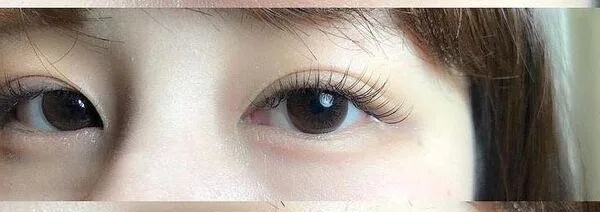
- ShapeMonolid — no crease, so the lash line sits low on one flat plane.
- EffectModified cat: length climbs the whole way and never comes back.
- Where everyone strugglesEqual steps. One oversized jump and the line kinks instead of travelling.
Why Why it is laid out this way
A monolid has no crease, so the lash line lies on a single flat plane and grows forward rather than up. The modified cat works with that instead of arguing with it: length climbs from the inner corner and simply keeps climbing, so the eye reads longer without anything having to lift off the lid. One strand on one strand leaves the climb fully exposed — there is no fan and no texture to cover an uneven step.
The order the zones go in
- Start the inner corner tinyInnermost zone stays the shortest thing on the map. The corner skin folds over it, so extra length there is spent for nothing.
- Climb one even step per zoneAdd the same small increase at every zone moving out. Equal steps are what makes the whole line read as one rise.
- Hold the last two zones levelThe final pair match each other and are the longest on the map. Going past them adds overhang, not stretch.
- Keep one curl familyOne curl the whole way, picked a touch stronger than you would use on a creased eye. Switching curl mid-line shows as a wobble here, not as texture.
- Cap thickness before lengthFine strands throughout. On a lid with no crease, a thick line is read as a dark band long before it is read as lashes.
The length curve on monolid eyes
The rise is the whole effect: with no crease to interrupt the lash line, the eye follows one unbroken climb from corner to tail. Equal steps keep that climb reading as a line rather than as a set of stages. The two matching zones at the end give the tail enough body to finish the stroke without setting up a second high point.
Where does a cat-eye map go wrong on monolid eyes?
Deep The physics underneath
Above is the layout. Below is what the last two zones are actually being asked to hold up.
The same map, built four ways
- Classic 1:1
- This cell. The rise is drawn by length alone, so every step is honest and every error is legible from across the room. The cost is that the tail's body has to be bought with length, which is the most expensive currency on this map.
- Handmade volume
- Splitting the tail's length across several finer strands would give the same outline for less mass on the map's weakest zone. That trade is the whole reason a volume version of this map exists.
- Promade / pre-made fans
- A ready fan leaves a small knot of material at the root. With no crease, the root sits proud of the skin all day, so a bulky base is noticed here sooner than on a lid that folds over it.
- Woven / clover
- A spread that repeats identically fights a climbing map — the eye picks up the repeat and the rise turns into rows. Keep it inboard of the last three zones or leave it out.
Spread angle versus weight
There are no fans in this cell, but the tail poses the same question: anything you place on the two matching zones sits furthest out on the finest natural lashes of the lid. Width out there costs what length costs and returns less rise. Whatever you build at the tail, keep it narrow and sitting on the lash's own line.
What a monolid lash line can carry
- Droop is the ceiling here, not shedding. Once an extension's mass beats the natural lash's stiffness, that strand settles forward over the eye — and on a flat plane there is no fold above it to make the drop invisible.
- The rise puts its longest strands on its finest supports: the outer third carries the map's maximum length on the lid's thinnest lashes, so the lever is longest exactly where the anchor is weakest.
- Grade the outer third by its thinnest strands, not by how the block looks. That zone fails at the rate of its weakest lashes, and every one of them is carrying the map's top length.
Where this map fails first
Two ends, two different failures. At the inner corner nothing breaks — the corner skin simply covers what you put there, so the work is invisible from day one. At the tail the failure is mechanical: the longest strands sit on the finest lashes, they settle forward first, and once they do the climb stops rising and turns into one long level line. Map the tail so it can afford to lose a few and still read as a rise.
FAQ Common questions
Is a cat-eye safe on monolid eyes?
This modified version is — it is the map most techs default to on a monolid. It gains length by climbing steadily rather than by dumping length at the corner, so nothing has to lift off a flat lid to work.
Why do the last two zones stay the same length?
So the tail has body without a second high point. If the very last zone overshoots, those strands hang past the lid edge and the eye reads weight instead of stretch.
Should the curl be stronger than on other eye shapes?
Slightly. Without a crease the lash line points forward instead of up, so a curl that looks strong on a creased eye can still read flat here — go a step firmer and check it with her eyes open.
Why not just make the inner corner longer to balance it?
The corner skin folds over that zone, so the length is hidden and the weight is not. It is the one place on this map where spending gets you nothing back.
Print this page or save it as PDF — the diagrams are drawn to stay readable in black and white on plain paper. Or download the diagrams below as SVG. No account, no fee, nothing to sign. Every file carries this page’s address, so wherever it ends up it can be traced back here.
Teaching from these? The offer, and how to credit it.
Also in: Monolid eyes · Cat-Eye · Classic 1:1
Read next: what a cat eye lash map actually is · questions clients ask about lash extensions