Monolid Eyes · Cat-Eye · Hybrid
The cat-eye lash map for monolid eyes, built in Hybrid — zone order, where the length peaks, and the point this one usually goes wrong.
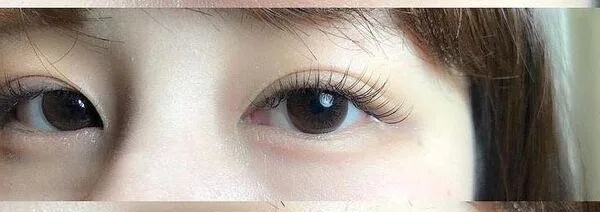
- ShapeMonolid — one flat lid plane, lash line low and facing forward.
- EffectModified cat with texture: a steady grade, broken up rather than smoothed.
- Where everyone strugglesTexture is punctuation. If a spike outranks the grade, the map is gone.
Why Why it is laid out this way
Texture is what clients mean when they say a set looks like lashes and not like a strip. On this map the grade does the work — length steps up zone by zone and holds level across the last pair — and the mixed strands are only there to stop that grade looking machined. The order matters: build the grade first, then decide where a fan or a spike is allowed to interrupt it.
The order the zones go on, and where the fans land
- Lay the singles firstSet the grade with single strands, one even step per zone, inner corner shortest. This is the spine and it gets built before any fan touches the lid.
- Fill between with soft fansDrop light open fans into the gaps to thicken the line without changing any zone's length. Fans add darkness, singles hold the shape.
- Put the texture in the outer halfKeep spikes and obvious texture past the middle, where the grade is already tall enough to carry them. Texture near the inner corner just looks like a mistake.
- Match spikes to their own zoneA spike sits a clear step above the zone it lives in, not above the map. Longer than that and it hangs over the eye instead of pointing out of it.
- Check texture with her eyes openClosed eyes flatter every hybrid. Sit her up, look at the tail from the front, and cut any spike that has folded forward.
The length curve on monolid eyes
The diagram shows an unbroken grade with two level zones at the end, and that is what the singles are drawing. Fans and spikes ride on top of it without changing any zone's height, so the eye still travels the same path from the corner outward. Texture that shifts a zone's length is no longer texture — it is a second map arguing with the first.
Where does a cat-eye map go wrong on monolid eyes?
Deep The physics underneath
A spike is not a decoration to the mechanics. It is the single heaviest object on this map, sitting on one natural lash.
The same map, built four ways
- Classic 1:1
- The singles here are structural, not filler — they own the step size and the level pair at the end. Keep them fine, because on a hybrid they are competing for room with everything else you are about to add.
- Handmade volume
- Open fans between the singles buy darkness at a discount: several thin strands weigh less than one thick one for the same width of cover. Spend that discount in the middle zones, where the grade is halfway up and can afford it.
- Promade / pre-made fans
- Fast and even, which is exactly the problem on a map whose selling point is that it is not even. Use them below the middle where uniformity does no harm, and hand-fan the outer half.
- Woven / clover
- Wide, repeating coverage per bond — useful under the grade as a base, useless as texture, since a repeat is the opposite of what a wispy edge is. It also lands its mass off the lash's line, which the outer zones cannot spare.
Spread angle versus weight
Opening a fan does not add material, it only moves the material sideways off the lash's own line, and a strand carrying its weight off-line will slowly turn to relieve the twist. On this map the last two zones are already the tallest and the finest-supported, so a wide fan out there shows its turn within days as a tilted, blurred tail. Run wide fans inboard and narrow ones past the middle.
What a monolid lash line can carry
- The visible failure on a hybrid is not thinning, it is the texture flattening: spikes and fans lie down onto the lid plane while the singles stay put, and the deliberate irregularity turns into a smear.
- A spike is mechanically one thick strand — all of its mass on the axis and the longest thing on the lid. Budget one against a single lash's ceiling, never against a fan's.
- Two lashes in the same zone do not have the same allowance. Put your spikes on the strands that are visibly stouter than their neighbours, and give the thin ones a plain single.
Where this map fails first
The outer half goes first because that is where you put the tallest objects on the finest lashes. Spikes turn forward before they fall — the client reads that as the set looking messy, not as the set failing. Behind them the tail thins, and because this map has no peak to lose, what you actually lose is the last even step. Keep the texture past the middle sparse enough that losing a few of them changes nothing.
FAQ Common questions
What does hybrid actually change on a monolid cat map?
It changes the edge, not the shape. Single strands still set every zone's length; the fans and spikes only make the top of the line irregular so it reads as lashes rather than as a band.
How long should a spike be on this map?
One clear step above the zone it sits in — no more. On a flat lid there is nothing above the lash line to catch a tall spike, so it folds forward over the eye instead of pointing away from it.
Can I put texture at the inner corner?
Not usefully. The corner skin folds across those lashes, so texture there is hidden while its weight is not; keep the inner third plain and start the interest past the middle.
Do fans or singles set the length here?
Singles. If fans are deciding zone lengths you have lost control of the step size, and an uneven step is the one thing this map cannot absorb.
Print this page or save it as PDF — the diagrams are drawn to stay readable in black and white on plain paper. Or download the diagrams below as SVG. No account, no fee, nothing to sign. Every file carries this page’s address, so wherever it ends up it can be traced back here.
Teaching from these? The offer, and how to credit it.
Also in: Monolid eyes · Cat-Eye · Hybrid
Read next: what a cat eye lash map actually is · questions clients ask about lash extensions