Monolid Eyes · Cat-Eye · Volume
The cat-eye lash map for monolid eyes, built in Volume — zone order, where the length peaks, and the point this one usually goes wrong.
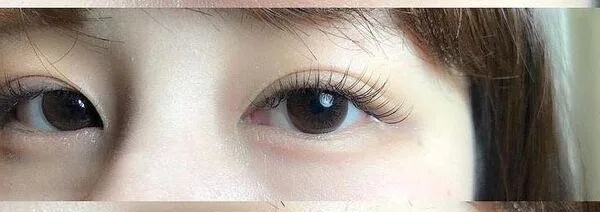
- ShapeMonolid — flat lid plane, low lash line, nothing to hide weight under.
- EffectModified cat in fans: a steady step up, holding level across the outer pair.
- Where everyone strugglesFans buy darkness, not length. Density at the tail is what closes the eye.
Why Why it is laid out this way
Every zone on this map is longer than the one before it, which means the weight per lash is rising the whole way out — and volume is the technique that lets you keep raising cover without keeping on raising weight. Split the material finer and you gain darkness for far less mass than a thicker single strand would cost. On a lid with no crease, that discount is not a nice-to-have; it is the only reason the map survives to the tail.
The order the zones go on, fan by fan
- Set the step size in fans, not laterDecide the zone-to-zone increase before you place anything, and keep every fan in a zone to that length. Correcting a fan's length afterwards means removing it.
- Keep the inner corner a whisperSmallest, narrowest fans at the inner zones — barely a fan at all. Corner skin folds over them, so density there buys nothing visible.
- Build a base layer, then a top layerLay a wider fan layer low against the lash line, then a narrower directional layer over it. One layer at one width goes flat on a flat lid.
- Narrow the fans as the length growsWide fans through the middle, tighter fans across the outer pair. The longest zones need direction, not width.
- Spend the weight budget outwardWhatever total load you will allow, most of it belongs in the middle where the lashes are strongest, not stacked on the last two zones.
- Sit her up before you closeFront-on, eyes open, look for any fan that has settled forward over the eye. That is your ceiling telling you it has been passed.
The length curve on monolid eyes
The line steps up evenly and then holds level across the outer pair, so the two longest zones are also the two carrying the most extension per natural lash. Fans let you fill that outer block with cover instead of with bulk, keeping the shape while the load stays inside what a fine lash line can hold. Break the even step and the fans stop reading as one line and start reading as clumps.
Where does a cat-eye map go wrong on monolid eyes?
Deep The physics underneath
Fans change the price of cover. They do not change what a single natural lash is willing to hold.
The same map, built four ways
- Classic 1:1
- One strand per lash makes the outer block honest but expensive: the only way to make it fuller is to make it thicker, and mass climbs far faster than diameter does. On the map's longest zones that is the wrong direction.
- Handmade volume
- This cell, and the reason to choose it. Several fine strands give the width of one thick one at a fraction of the mass, and you can retune the width fan by fan as the zones get longer.
- Promade / pre-made fans
- Even and quick across a dense set, at the cost of a firmer, thicker base. Bases sit exposed on a lid with no fold, so keep ready fans in the middle zones and hand-make anything going on the outer pair.
- Woven / clover
- Excellent cover per bond, but it fixes the spread for you, and this map needs the spread to keep narrowing as it goes out. Use it as a base layer inboard and never as the top layer at the tail.
Spread angle versus weight
A fan's spread does not change how much material is on the lash — it changes how far off the lash's own line that material sits. The outer pair here carries the longest extensions on the finest lashes, so an off-line load there is the one that turns, and a turned fan at the tail reads as a smudge instead of a point. Run the widest fans through the middle third and let the width close down as the length opens up.
What a monolid lash line can carry
- The first thing you lose is not fans, it is angle: a natural lash bends forward under load long before it lets go, and on a flat plane a bent lash lands in front of the eye where every bit of it shows.
- Because the map's tail is also its longest zone, mass and reach peak together there. Adding one more strand to an outer fan costs more in bending load than the same strand added anywhere else on the lid.
- Fan a strong lash, single a weak one. A zone's real allowance is set by its thinnest natural lashes, and putting a fan on those is how an even outer block turns into a gappy one in a fortnight.
Where this map fails first
Failure concentrates in the outer pair, and it starts as rotation rather than loss. Those fans are the longest and are sitting on the lid's finest lashes, so they lean forward and turn on their own axis; the tail loses its point and the whole line stops looking like it is going anywhere. Only after that do the bases start letting go, usually the wide ones first. Build the outer pair lighter than you think it needs, because it is the part of the map that has no margin left.
FAQ Common questions
Is volume too heavy for monolid eyes?
Not by itself — done properly it is lighter than a thick classic set for the same darkness. The failure mode is using volume to add material rather than to redistribute it, which a flat lid shows immediately.
How wide should the fans be at the tail?
Narrow. Those zones are already the longest, and a wide fan puts its outer legs off the lash's line where they slowly twist, so the tail blurs instead of pointing.
Why two layers instead of one?
A single layer at a single width flattens against a lid with no crease and reads as a dark band. A wider base with a narrower layer over it gives the line depth from the front, which is the only angle that matters here.
Where should the extra density go?
The middle zones. They sit on the strongest natural lashes and carry mid-length extensions, so they absorb density without dropping — unlike the outer pair, which is already at its limit on length alone.
Print this page or save it as PDF — the diagrams are drawn to stay readable in black and white on plain paper. Or download the diagrams below as SVG. No account, no fee, nothing to sign. Every file carries this page’s address, so wherever it ends up it can be traced back here.
Teaching from these? The offer, and how to credit it.
Also in: Monolid eyes · Cat-Eye · Volume
Read next: what a cat eye lash map actually is · questions clients ask about lash extensions