Monolid Eyes · Doll / Open-Eye · Hybrid
The doll lash map for monolid eyes, built in Hybrid — zone order, where the length peaks, and the point this one usually goes wrong.
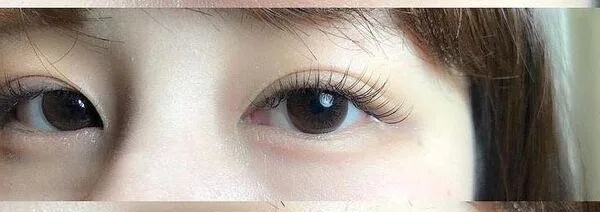
- ShapeMonolid — one flat lid plane; the lash line has nowhere to tuck away.
- EffectDoll with texture: a tall middle, softened edges, both sides falling evenly.
- Where everyone strugglesKeep the middle clean. Texture through the tall zone kills the round read.
Why Why it is laid out this way
A round map and a broken, wispy edge want opposite things: one needs a smooth curve to be legible, the other exists to interrupt smoothness. The way they coexist here is by division of labour — singles draw the curve, mixed strands rough up the two falling sides, and the tall middle is left alone. Whether the map suits her at all is still decided at the consultation, because a raised centre only opens a monolid whose lid sits lightly over the lash line.
The order the zones go on, and where the fans land
- Look at the lid before anything elseFront-on with her eyes relaxed. If the lid plane sits over most of the lash line, this map will read closed and you should offer another one.
- Draw the curve in singlesShort inner corner, quick rise, tall middle, even fall to a short tail — all in single strands, before any fan goes on.
- Leave the tall middle plainNo spikes and no obvious texture through the highest zone. That zone is carrying the whole round effect and it needs to be readable.
- Texture the two fallsWork fans and the occasional spike into the descending zones each side, so the edge softens as it comes down. Irregular there, smooth at the top.
- Keep both sides equally busyTexture one side more than the other and she gets two different eyes. Match the amount, not the exact placement.
The length curve on monolid eyes
The shape above is one tall zone with matched falls, and a round result depends entirely on those falls matching. Singles hold that geometry because their length is fixed and visible; the mixed work sits underneath and around it, adding darkness and a broken edge without moving any zone's height. The middle is raised more than it would be on a creased eye because a flat lid absorbs part of the height before it ever reaches the front view.
Where does a doll map go wrong on monolid eyes?
Deep The physics underneath
Mixed techniques on one lid means mixed bond behaviour on one lid. That shows up as an uneven grow-out long before it shows up as a loss.
The same map, built four ways
- Classic 1:1
- The singles carry the geometry here — the tall zone and both rates of fall. Keep them the finest thing on the map, because everything else you add is competing for space on the same lashes.
- Handmade volume
- Open fans on the falling sides give darkness for very little mass, which is exactly where you want the cheap material: away from the tall middle where the lid presses hardest.
- Promade / pre-made fans
- Uniform and quick, which suits the plain zones and undercuts the textured ones. Their firmer base is also worth keeping off the middle, where a monolid's lid rests directly on the lash roots.
- Woven / clover
- Broad cover per bond and a repeating spread — useful as filler low on the sides, wrong anywhere the edge is meant to look accidental. Never on the tall zone, which needs height rather than width.
Spread angle versus weight
Spread moves material sideways off the lash's line without reducing any of it, and material sitting off-line makes the strand slowly turn. On this map that turn is most costly on the two zones flanking the tall middle: when they twist, the fall stops being smooth and the round outline goes lumpy. Fan wide only at the bottom of each fall, and keep everything within a zone of the middle narrow and upright.
What a monolid lash line can carry
- What gives first here is the smoothness, not the density. A couple of tired strands beside the tall zone put a notch in a curve that only works while it is continuous.
- The middle zone spends all day under the lid plane as well as under its own weight, so its usable length is shorter than the same strand would manage on the sides. Treat the top of the map as having less allowance than the numbers suggest, not more.
- Reserve the spikes for lashes that are visibly stronger than their neighbours. A spike weighs like one thick single strand, and hanging one on a fine lash costs you both the spike and the lash it sat on.
Where this map fails first
Losses on the sides matter more here than losses at the ends, because the shape is a curve and a curve fails at any point along it. The zone just inside the tall middle usually notches first, since it carries near-maximum length on lashes that are still fine. Once the middle itself settles forward, the map does not look sparse — it looks flat, which the client reads as the set having stopped working rather than having thinned. Spread the texture so no single strand is load-bearing for the curve.
FAQ Common questions
Why keep texture out of the tall middle?
Because the middle is the only zone doing the round effect. Break its outline with spikes and the eye reads a jagged edge instead of a curve, which is the opposite of what a doll map is for.
Does hybrid make a doll map suitable for a heavier lid?
No. Texture changes the edge, not the height, and the reason a doll map fails on a heavily covered monolid is that the height is hidden. Change the map, not the technique.
How do I keep the two sides matching?
Match the amount of texture rather than copying its exact positions. Equal counts each side keeps the falls balanced while the placements stay irregular enough to look natural.
Where do spikes go on this map?
Low on each fall, a clear step above their own zone and never above the middle. Anything taller than the middle rewrites the map.
Print this page or save it as PDF — the diagrams are drawn to stay readable in black and white on plain paper. Or download the diagrams below as SVG. No account, no fee, nothing to sign. Every file carries this page’s address, so wherever it ends up it can be traced back here.
Teaching from these? The offer, and how to credit it.
Also in: Monolid eyes · Doll / Open-Eye · Hybrid
Read next: open eye versus doll — one family, two intents · questions clients ask about lash extensions