Monolid Eyes · Natural · Classic 1:1
The natural lash map for monolid eyes, built in Classic 1:1 — zone order, where the length peaks, and the point this one usually goes wrong.
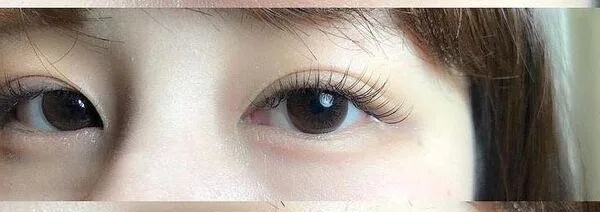
- ShapeMonolid — no crease, so a soft taper simply disappears into the lid.
- EffectNatural: one level band across the zones that show, corners cut right back.
- Where everyone strugglesThis is the weakest monolid map. Say so before you start, not after.
Why Why it is laid out this way
Most teaching on this shape says the same thing about natural mapping: do not, because a gentle taper on a flat lid is absorbed by the lid and the client sees almost nothing for her money. This page exists because clients still ask for it, and because there is a version that behaves — hold one level length across the zones that actually show, and give up both corners deliberately rather than fading into them. Offer it knowing it is the least effective map in this shape's set.
The order the zones go in
- Have the conversation firstTell her a natural map reads quieter on a lid with no crease and show her the alternatives. A client who chose the compromise is happy with it; one who was not told is not.
- Concede both cornersInnermost two zones and the outermost zone stay very short — near her own length. They are covered or turned away, so nothing spent there comes back.
- Hold one level bandMiddle and outer-middle zones all sit at the same length, the map's longest. Level, not peaked — a peak makes it a different map.
- Start the band clear of the foldBegin the level run just past where the corner skin stops covering the lash line. Starting inside the fold wastes the first zone of it.
- Take the curl up a stepOne curl family the whole way, chosen firmer than a creased eye would need. Without lift, a level band just sits forward over the eye.
- Keep the strands fineNothing thick anywhere. If the set has to be quiet, quiet cannot also be heavy.
The length curve on monolid eyes
The drawing is deliberately blunt: a flat top across four zones, dropping away at both ends. On a lid with no crease there is no fold above the lash line to make a graded taper visible, so a taper reads as nothing at all while a level run reads as lashes. Both corners are given up on purpose — one is under skin, the other turns away from the viewer — and everything the map has left goes into the part she can actually see.
Where does a natural map go wrong on monolid eyes?
Deep The physics underneath
A level band is mechanically the simplest thing in this library and the least forgiving: four zones at one length, so every strand is carrying the maximum.
The same map, built four ways
- Classic 1:1
- This cell. One strand per lash across a level run makes the band as light as it can be, and light is the only advantage this map has. It also means the band's darkness is limited by how fine you keep the strands.
- Handmade volume
- Fanning would let the band look fuller without weighing more, which is tempting on a map that struggles to be seen. It also stops the set being natural in anything but name, so use it knowing what you are trading.
- Promade / pre-made fans
- A ready fan's base is bulkier than a single strand's, and this map has no drama anywhere to distract from a base sitting proud on a flat lid. Poor value in a set whose only asset is discretion.
- Woven / clover
- Broad cover for one bond, and a repeat the eye picks up quickly across four identical zones. On a level band, a repeating spread is the fastest way to make a natural set look manufactured.
Spread angle versus weight
There is no fan here, but the same rule governs the band: everything sits on the lash's own line, so nothing carries a twist and nothing turns. That is why a plain level run holds its look longer than a fuller version of the same map — the whole band ages evenly instead of blurring in patches. If you later add width to any zone of it, add it in the middle of the band and never at either end.
What a monolid lash line can carry
- This map's ceiling shows up as a sag rather than a gap: four zones at one length means they all approach their limit together, and when they lean forward the band lies over the eye as one piece.
- Level does not mean equally loaded. The band's outer zones sit on finer natural lashes than its middle ones, so the same length is a heavier ask at the outer end and that end tires first.
- The weakest strands set the band's real length. One shared length across four zones only works if you pick that length for the thinnest lashes in the run, not for the average of it.
Where this map fails first
Both ends of the band go before its middle. At the inner end the join is abrupt by design, so losing even a couple of strands there turns a clean start into a ragged one. At the outer end the lashes are finest and the same length is the biggest ask on the map, so that end leans forward and the band stops being level. Since level is the entire effect, this map looks finished sooner than a shaped one does — worth saying at booking, not at the refill.
FAQ Common questions
Why is a natural map discouraged on monolid eyes?
Because a soft taper needs a crease or a fold above the lash line to read against, and a monolid has neither. The gradient is absorbed by the lid and the client sees very little change.
What should I offer a client who insists on natural?
Show her a map with a defined high zone past the middle first — it is still quiet but it actually shows. If she still wants natural, run the level band version here and set expectations in the consultation.
Why are both corners left so short?
The inner corner is under a fold of skin and the outer turns away from a front-on view, so length in either place is spent where nobody sees it. Concentrating everything in between is what makes the map visible at all.
Should the band be one length or a slight curve?
One length. A slight curve is exactly the gradient this lid absorbs, and it costs the band its only readable feature.
Print this page or save it as PDF — the diagrams are drawn to stay readable in black and white on plain paper. Or download the diagrams below as SVG. No account, no fee, nothing to sign. Every file carries this page’s address, so wherever it ends up it can be traced back here.
Teaching from these? The offer, and how to credit it.
Also in: Monolid eyes · Natural · Classic 1:1
Read next: questions clients ask about lash extensions