Monolid Eyes · Natural · Hybrid
The natural lash map for monolid eyes, built in Hybrid — zone order, where the length peaks, and the point this one usually goes wrong.
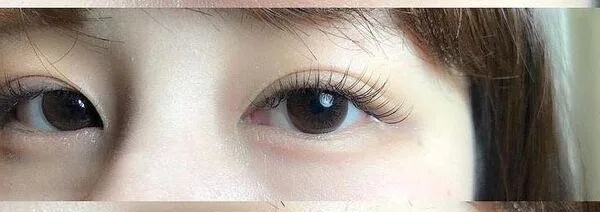
- ShapeMonolid — flat lid plane; a quiet gradient is absorbed and never seen.
- EffectNatural in a mix: level length, with a slightly broken top edge.
- Where everyone strugglesTexture here is a whisper. Push it and you have sold her a wispy set.
Why Why it is laid out this way
If a level band is going to be noticed at all on a lid with no crease, the top edge is where it has to happen — you cannot add length without changing the map and you cannot add weight without changing the shape. Mixing a few fans and the odd raised strand into a single-strand band gives it a slightly uneven top that catches light, at almost no extra load. Done past that point it is not a natural set any more, and both of you should be clear about which one she booked.
The order the zones go on, and where the fans land
- Agree the brief out loudConfirm she wants quiet, not full. A hybrid natural map can go two ways and the difference is a client conversation, not a technique.
- Build the band in singlesSet the level run first with single strands, both corners kept very short. The band's length is fixed before anything else lands.
- Slip fans in, low and lightSmall open fans between the singles, sitting no taller than the band. They add depth to the line, not height to the map.
- Raise only a few strandsA scattered handful sitting a fraction above the band — countable on one hand per eye. More than that and the level read is gone.
- Keep the corners plainNo fans and nothing raised in the conceded zones. Texture where the skin folds over just looks like stray hairs.
The length curve on monolid eyes
The band is level by design, so height cannot carry this map and depth has to. Mixing strand types under one fixed length gives the run a top edge that is not perfectly straight and a body that is not perfectly flat, which is what makes it read as lashes on a lid with nothing above it to cast the line against. The corners still get nothing, because a fold and a turned-away tail do not become visible just because you made the middle more interesting.
Where does a natural map go wrong on monolid eyes?
Deep The physics underneath
Two bond types across four identically loaded zones. They do not age at the same rate, and that is the whole story of how this set looks in three weeks.
The same map, built four ways
- Classic 1:1
- The singles are the map. They hold one length across the run and give the band a straight enough top that any small break in it reads as intentional.
- Handmade volume
- A few fine fans buy depth for very little mass, which is the only currency a quiet map can afford to spend. Keep them level with the band and never above it.
- Promade / pre-made fans
- Identical fans in a set whose value is in being slightly irregular, on a base thicker than the singles beside them. A poor match here in look and in feel.
- Woven / clover
- It covers a lot of ground per bond, but a fixed repeated spread across four equal zones is the exact pattern this map is trying not to have.
Spread angle versus weight
Every fan you open puts part of its material off the lash's own line, and that off-line load makes the strand turn a little over time. In a band whose only feature is a level top, a few turned fans is what changes gentle texture into a fuzzy edge. Keep the fans narrow, put the widest of them in the middle of the run, and leave the two ends of the band in plain singles.
What a monolid lash line can carry
- The failure to expect is the band flattening in feel, not in height: the fans settle sooner than the singles, so the depth goes first and the map is left as a bare level line.
- Every zone in the run carries the same length, so a fan added anywhere in it is the heaviest thing that zone has. Add fans where the natural lashes are visibly stouter, not on a regular spacing.
- A raised strand costs like a thick single. Spend those on strong lashes, and accept that when one of them goes, the texture it was providing goes with it.
Where this map fails first
Because the map has no high point, it does not fail as a lost shape — it fails as a loss of interest. The fans give up their depth first, since they are the heaviest thing on the lightest map, and the line reverts to flat singles. The band's outer end then thins because it carries the run's shared length on the finest lashes there. Keep the texture spread thin enough that the set still reads as level when a third of it has gone.
FAQ Common questions
What does hybrid buy on a natural monolid map?
Depth, not height. The length stays level, and mixing strand types gives the line a slightly broken top edge so it registers on a lid that would otherwise absorb it.
How much texture is still natural?
A scattered handful of raised strands per eye and light fans sitting level with the band. Past that the set reads as wispy, which is a different booking and a different price.
Should the fans be longer than the singles?
No. They sit at the same length as the band or a fraction under it. A fan above the band puts a high point on a map defined by not having one.
Is this map worth doing at all on a monolid?
It is the most defensible version of a map that is not recommended for this shape. If she is open to alternatives, a defined high point past the middle gives her far more for the same time in the chair.
Print this page or save it as PDF — the diagrams are drawn to stay readable in black and white on plain paper. Or download the diagrams below as SVG. No account, no fee, nothing to sign. Every file carries this page’s address, so wherever it ends up it can be traced back here.
Teaching from these? The offer, and how to credit it.
Also in: Monolid eyes · Natural · Hybrid
Read next: questions clients ask about lash extensions