Monolid Eyes · Squirrel / Fox · Volume
The squirrel lash map for monolid eyes, built in Volume — zone order, where the length peaks, and the point this one usually goes wrong.
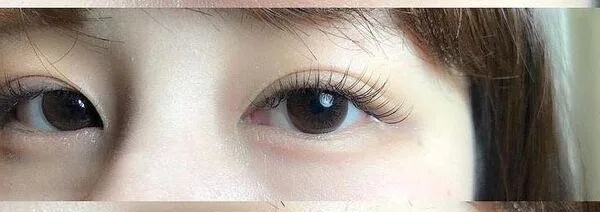
- ShapeMonolid — flat lid plane; anything heavy is seen from the front all day.
- EffectSquirrel in fans: height in the outer third, density gathered below it.
- Where everyone strugglesDo not make the peak the densest zone. Height and darkness are not the same buy.
Why Why it is laid out this way
It is tempting to put the biggest fans exactly where the map is tallest, and on this shape that is the mistake that costs most. A monolid lash line has nothing above it to absorb weight, so a dense high zone reads as a dark clump instead of a point, and it is sitting on the finest lashes of the lid. Gather the density in the zones below the peak, keep the peak itself lean and pointing, and the map holds up in both look and wear.
The order the zones go on, fan by fan
- Give the covered corner nothingWhere the corner skin lies over the lash line, use the smallest fans in the set or leave the lashes bare. It is the one place on this map where doing less costs you nothing.
- Exaggerate the climbStep the length up more decisively than you would in a classic set. Fans already make the line look fuller, and a full line hides a small step.
- Gather the density below the peakPut your widest, fullest fans in the zones leading up to the high point, on the strongest lashes of the lid. They can carry it and the peak cannot.
- Build the peak leanNarrow, fine fans at the high zone, taking their presence from length and curl. A point is what the map needs there, not a mass.
- Step down in two movesEase the length and the fan width down together after the peak so the tail thins as it shortens.
- Take the curl a step firmerOne curl family, chosen stronger than a creased eye would need — a flat lid gives back less lift than you expect from the same curl.
The length curve on monolid eyes
The curve puts a single high zone in the outer third and comes down again, and in fans that shape has to be drawn with length alone. Density is a separate control, and it belongs where the natural lashes are strongest — the middle zones under the climb — not on the outer lashes carrying the map's longest extensions. Read the drawing as heights and you will not be tempted to make the tallest zone the heaviest one too.
Where does a squirrel map go wrong on monolid eyes?
Deep The physics underneath
Volume buys cover per unit of mass. On this map the question is which zone deserves to spend that discount.
The same map, built four ways
- Classic 1:1
- Single strands make the peak's height plain and its fullness expensive, since the only way to darken it is to thicken it. On the outer third of a monolid that runs out of headroom quickly.
- Handmade volume
- This cell. Fine strands split across a lash give the climb its body cheaply and, crucially, let you narrow the fan as the zones get taller — the control this map lives on.
- Promade / pre-made fans
- Consistent through the low and middle zones where consistency is welcome. Keep them off the high zone: a firmer base at the tallest point sits proud on a lid with nothing to cover it.
- Woven / clover
- A lot of cover for one bond, with the spread decided for you. Useful in the climb, wrong at the peak, where the map wants the width closing rather than fixed.
Spread angle versus weight
Every degree you open a fan moves material away from the lash's own line without reducing any of it, and the strand slowly turns to relieve what it is carrying sideways. At the high zone that turn is fatal to the effect: a peak reads as a point only while its fans still face the same way. Let the fans be widest in the middle of the climb and tightest at the top, and the map ages in the shape you built it in.
What a monolid lash line can carry
- The first thing to go is the point, not the density: the peak's fans lean forward on the lid's finest lashes and the outer third settles into a level line while everything is still attached.
- The high zone pays twice for every extra strand — it is the longest zone on the map, so the same material sits further out from the root than it would anywhere else. That is the arithmetic behind keeping the density below the peak.
- A fan is one object hanging on one natural lash. Splitting the material does not raise what a fine outer lash will hold, so leave the thinnest strands in the peak zone with a single or with nothing.
Where this map fails first
Both problems live in the outer third, for the same reason: it holds the map's longest extensions on its finest lashes. The peak's fans lean forward first and the point flattens, which the client reads as the set having stopped working. Behind them the tail bases loosen, helped along by a pillow and a towel on a lash line that sits out in the open. Build the peak with fewer, finer fans than the zone would take, so that losing a couple of them does not cost you the shape.
FAQ Common questions
Should the peak be the densest part of a volume squirrel map?
No. Height comes from length and curl; density is a separate control and belongs on the stronger lashes below the peak. A dense high zone on a monolid reads as a clump and fails first.
How wide should the fans be at the high zone?
Narrow. A wide fan puts material off the lash's line where it slowly turns, and a turned fan at the top of the map blurs the point the whole set is built around.
Why exaggerate the length steps in volume?
Because fans make the line look fuller, and fullness disguises a small rise. What reads as a clear climb in single strands can read as level once the gaps are filled.
What goes on the inner corner in this version?
Almost nothing — the smallest fans in the set, or bare lashes. The corner skin covers that stretch, so density there buys no visible lash and costs retention.
Print this page or save it as PDF — the diagrams are drawn to stay readable in black and white on plain paper. Or download the diagrams below as SVG. No account, no fee, nothing to sign. Every file carries this page’s address, so wherever it ends up it can be traced back here.
Teaching from these? The offer, and how to credit it.
Also in: Monolid eyes · Squirrel / Fox · Volume
Read next: fox eye and squirrel lash mapping, and how they differ · questions clients ask about lash extensions